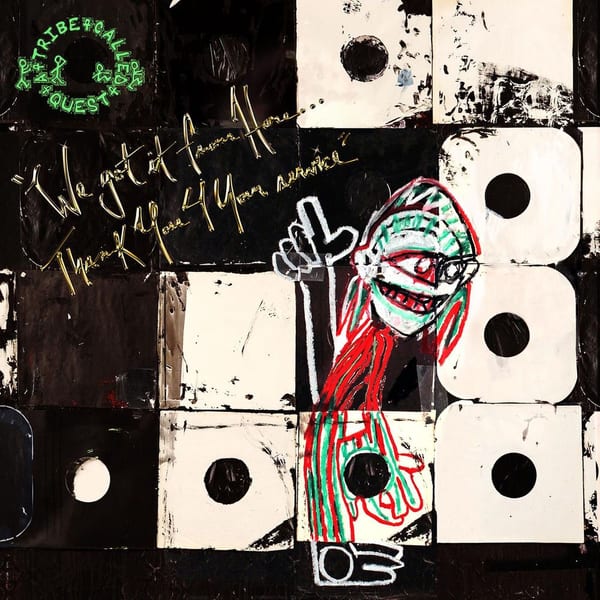
We Got It from Here at 10: A Tribe Called Quest said goodbye over Black Sabbath
Tribe's farewell still doesn't sound like a reunion record ten years on. The sample credits explain a lot of why.
Deep DiveRiffiter6 min read
We Got It from Here... Thank You 4 Your Service is A Tribe Called Quest's sixth and final album, released by Epic on November 11, 2016, eight months after Phife Dawg died. Q-Tip produced it at his New Jersey home studio, it debuted at No. 1 on the Billboard 200, and its samples come from Black Sabbath, Can, Gentle Giant and Elton John rather than the jazz records the group was known for.
For thirty years one label followed A Tribe Called Quest around: jazz rap. They earned it. Ron Carter, the most recorded bassist in jazz history, played on "Verses from the Abstract" on The Low End Theory in 1991, and the group's best years were built on upright bass and soul-jazz loops.
So it's worth noticing what happens on the second track of their last album. "We the People...." runs on the drum break from Black Sabbath's "Behind the Wall of Sleep", off the band's 1970 debut. Organized Noize had used the same break for OutKast's "Hootie Hoo" in 1994, and André 3000 turns up a few songs later on "Kids...". It's a small wink to the crate diggers, and it sets the terms for the whole record.
We Got It from Here... Thank You 4 Your Service came out on Epic on November 11, 2016, ten years ago this week. It debuted at No. 1 on the Billboard 200 with 135,000 units, twenty years after Beats, Rhymes and Life had done the same, at the time the longest gap between No. 1 albums for any hip-hop act. Those are the least interesting facts about it.
Q-Tip went to different crates
Q-Tip produced the album with Blair Wells at the AbLab, his home studio in Englewood Cliffs, New Jersey, and the sample credits read like somebody else's record collection. "Mobius" is built on Gentle Giant's "Prologue", the opener of their 1972 album Three Friends. "Ego" borrows from György Ligeti's Requiem. Elton John sings and plays piano on "Solid Wall of Sound" over a sample of his own "Bennie and the Jets", and Jack White plays guitar on three tracks. "Lost Somebody", the song the group made for Phife Dawg, sits on the piano from Can's "Halleluhwah".
That last one is a deep pull. "Halleluhwah" fills the entire second side of Tago Mago, eighteen and a half minutes of Jaki Liebezeit holding one groove, and it's on our new list of side-long songs. The obvious thing to lift from that record is the drums. Q-Tip took the piano.
By 2016, jazz rap was a style other people made. Twenty-five years of producers had worked through the same soul-jazz records Tribe once had to themselves, and a reunion album built on upright bass would have sounded like a tribute act playing Tribe songs. Switching crates is how Q-Tip avoided that. The drums still hit the way Tribe drums always did, and everything around them is new.
Phife is alive on this record
The reunion started on November 13, 2015, when the group performed on The Tonight Show, the same night as the attacks in Paris. Q-Tip has said that night is what sent them back into the studio. Sessions at the AbLab ran through the winter. Jarobi White, who left after the first album and had since become a professional chef, came back. Phife flew in from the Bay Area in week-long blocks scheduled around his dialysis. Ali Shaheed Muhammad was in Los Angeles scoring Luke Cage and joined by teleconference.
Phife died on March 22, 2016, at 45, from complications of diabetes. The album title was his, and the others kept it.
Most posthumous rap albums sound assembled. Verses come off a hard drive, beats get built around them later, and a guest list fills the gaps. This one doesn't, because Phife was in the room for most of it. On "We the People...." he sounds quick and combative, a man halfway through an argument. The grieving happens on other songs. "Lost Somebody" is where the surviving members talk about him directly. The closer, "The Donald", takes its name from one of Phife's nicknames, Don Juice; released three days after the 2016 election, it had a lot of listeners assuming it meant somebody else.
The election came after the record was done
Recording wrapped in October. The album came out on November 11, Veterans Day, and on the 12th the group played Saturday Night Live with Dave Chappelle hosting, doing "We the People...." and "The Space Program". Q-Tip told The FADER that week they had been "trying to be honest and stay in-tune to our faculty and our meter regardless of what was happening." Jarobi was blunter: "Phife had the crystal ball on that one."
The chorus of "We the People...." chants a list of people who "must go": Black folks, Mexicans, poor folks, then Muslims and gays. It was written as a parody of campaign rhetoric. By the time most people heard it, it read like a news summary.
Passing the mic
The guest list is long. Busta Rhymes and Consequence come from the old extended family, and the newer names include André 3000, Kendrick Lamar, Kanye West, Talib Kweli and Anderson .Paak. On most reunion records that many famous friends would be a warning sign, guests papering over a group with little left to say. Here the guests come in for a verse or a hook and leave, and the songs stay Tribe songs. On "Dis Generation" Busta Rhymes takes the second verse over a hook lifted from Musical Youth's "Pass the Dutchie", and it's also the song where Q-Tip names Joey Bada$$, Earl Sweatshirt, Kendrick and J. Cole as the rappers who'll carry it on, and Kendrick shows up himself later on "Conrad Tokyo".
That generosity is what separates this record from the one that ended Tribe's first run. The Love Movement (1998) was made by a group on its way out the door, and you can hear it.
Ten years on
The reviews were close to unanimous at the time. Metacritic's average landed at 91, the best-reviewed hip-hop album of 2016 there. Pitchfork gave it a 9.0 and later put it at No. 44 on its list of the 200 best albums of the 2010s. Robert Christgau gave it an A+.
My ranking: it's the third-best Tribe album, behind The Low End Theory and Midnight Marauders and ahead of People's Instinctive Travels and the Paths of Rhythm. That is an absurd spot for a reunion record made around a dying member's dialysis schedule. I'd also call it the best final album in rap, and it isn't on our swan songs guide, which the comments are welcome to hold against us.
Rate it, then tell us where it sits in your own Tribe order. If you've got it above Midnight Marauders, make the case below.
Discussion
Disagree? Have a better record in mind? Say it — top takes rise.
Sign in to join the discussion.
No one's weighed in yet. Go first.