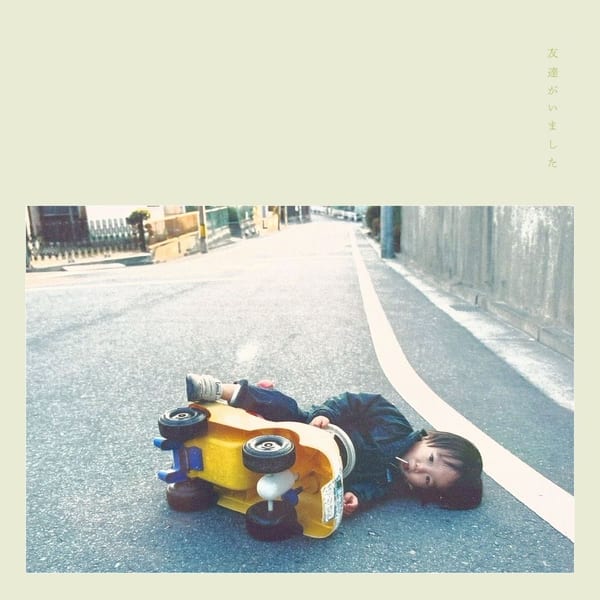
Trooper Salute's Tomodachi ga Imashita is a graduation album, and the songwriter had to sing the goodbye himself
A Nagoya college band's debut sits in RateYourMusic's 2026 top five, next to Boards of Canada and Neurosis. It opens with a song the band hadn't played live yet, closes with two they'd played for years, and the keyboard player takes the title track.
Deep DiveRiffiter6 min read
Tomodachi ga Imashita (友達がいました, "I Had Friends") is the debut album by Trooper Salute, a five-piece band formed at a university music club in Nagoya. Released on 17 June 2026 by Buriki Records and EIGHT BEATER, its 12 tracks run 55 minutes, and in October 2026 it was fifth on RateYourMusic's chart of the year's top albums.
Look at RateYourMusic's top albums of 2026 this month and the first four names are ones you'd expect: Boards of Canada's Inferno, Neurosis, Chat Pile, Slayyyter. Number five is a debut by five people who met in a university club in Nagoya. Tomodachi ga Imashita (友達がいました) translates as "I had friends", in the past tense, and the past tense is what the whole record is about.
I went looking for the English-language reviews and found a Qobuzissime write-up and a lot of Reddit threads. I couldn't find one on Pitchfork, Stereogum or the Quietus. Most of the Reddit posts start the same way, with someone saying YouTube or Discover Weekly served them "Zetsuen" out of nowhere. No English-language press campaign got it there. It climbed one recommendation at a time.
A band that started as a demo
Hayato Komiya, who plays keyboards and writes the songs, started making tracks with a DAW on an iPad in high school. He was a BiSH fan and listened to a radio show hosted by Kenta Matsukuma, the producer behind BiSH, which had a corner for listener demos. Komiya sent in an instrumental, and the feedback was that it would work better played by a band. So when he got to university in Nagoya, he put one together.
The singer came later. Musashi joined after Komiya heard her at karaoke singing a Yoshizawa Kayoko song. She also draws, and her illustrations were the band's visual identity before this album. They started gigging in January 2024. A self-titled EP came out that December, a second one in December 2025, and in between they played Fuji Rock.
The tag they use, "symphonic indie rock", came from a live house manager who asked them for a catchphrase. The two EPs show why it stuck. The first collects the poppier songs. The second, the band said, was designed as a gradient. It starts sunny and ends on "Fuji" (不治, "incurable"), an older and darker song with Yoshizawa Kayoko herself as a guest, written before the band existed and modelled partly on Mass of the Fermenting Dregs.
What the album is actually about
In a July interview with SPICE, the band gave the theme as 出会いと別れ, meetings and partings, and specifically the relationships you leave behind. Komiya has said the title song came from an "overwhelming sadness" at watching people around him turn into adults. They are five recent graduates who wrote a record about leaving school while they were in the middle of leaving it. One fan who saw them in Shibuya said on Reddit that from the records alone they had assumed the band was in its thirties.
Komiya told SPICE what he wants a listener to do with it: 置き去りにしてきたものをここからでいいからちゃんと見つめて、自分の中で成仏させてほしい. Roughly, look properly at what you left behind, even if you're only starting now, and let it rest. Musashi gave the other half: something very painful shouldn't be treated as the same thing as giving up on the future. Most records about lost friends pick one of those two positions. This one holds both.
The sleeve itself changed too. For the first time the cover is a photograph and not one of Musashi's drawings, and she told SPICE that was deliberate, a step away from the "cute girl" image the band had picked up.
The sequencing is the argument
The track order tells the story better than any single song does. "Doppler" (ドップラー) opens the album at 5:20, and according to the SPICE interview it hadn't been played live before the record came out. "Zetsuen" (絶縁, "cutting ties") comes next at 6:30, and that song, they told the same interviewer, had been around for three or four years. The record then gets lighter and stranger in the middle. Qobuz heard Shibuya-kei in "Warujie" (悪知恵), and "Utopia" is a 1:28 interlude. The last two tracks are the eight-minute title song and "Nare no Hate" (成れの果て), both songs the band had been playing for a long time.
So the album runs backwards. It starts with a song nobody had heard yet and ends with the ones the band has carried longest, which means the further you get into a record called I Had Friends, the further back you are in the band's own history. I don't know if they planned it as a joke on the title. It works either way.
Why Komiya sings the title track
Musashi is the band's voice. She calls herself the 語り部, the narrator, and she doesn't write lyrics. Komiya has said he writes female protagonists because a song with a male protagonist stops being pop. Then on the album he takes several leads himself, the eight-minute title track among them, with Musashi on backing vocals.
He explained it to SPICE in one line: これは本当に自分のアルバムだから, "this is really my album". He also said he probably won't sing again. The songwriter who built the band around someone else's voice steps out from behind it for the one song that's about him, and then says he's going back.
Some listeners don't like it. A commenter on r/japanesemusic said the male vocals drag some songs down. Fair enough. He's the keyboard player, and he told SPICE he sang because the album needed it, not because he wanted to. But if Musashi sang the title track it would be a story about somebody who lost their friends, and with Komiya singing it you're hearing the person it happened to.
The pop rule under the strings
None of the "symphonic" part would matter without the melodies, and Komiya is strict about those. He told SPICE that a melody is meaningless if you can't whistle it. The influences he lists in a CINRA interview are mostly pop: Sakanaction, Gesu no Kiwami Otome, Cornelius, Pizzicato Five, Sadistic Mika Band, Showa-era kayōkyoku. Kirinji's "Aliens" is his karaoke song. If you've read our city pop guide, you know that end of Japanese pop history well already.
The band he says hit him hardest at university was Mass of the Fermenting Dregs, the Kobe band that was a RYM favourite long before anyone had heard of Trooper Salute. MOTFD put out their sixth album, Iwaou, in August, two months after this one. Same summer, two generations.
Is it really a top-five record?
On the biggest r/japanesemusic thread about it, someone who likes the album said it's overrated by now, and I get it. Fifty-five minutes is long for a debut, and a band this new will have to show it can do it again. A chart of the year's best is a strange place to put a record whose main subject is finishing college.
But the album earns its spot by doing something most debuts don't try. It has a shape you can follow from the first track to the last, and it hands the microphone to its keyboard player for eight minutes because the song had to come from him. If you've already played it, put a score on it above. If you haven't, start with "Zetsuen", go back to "Doppler", and then tell us in the comments whether the title track works for you with his voice on it.
Discussion
Disagree? Have a better record in mind? Say it — top takes rise.
Sign in to join the discussion.
No one's weighed in yet. Go first.