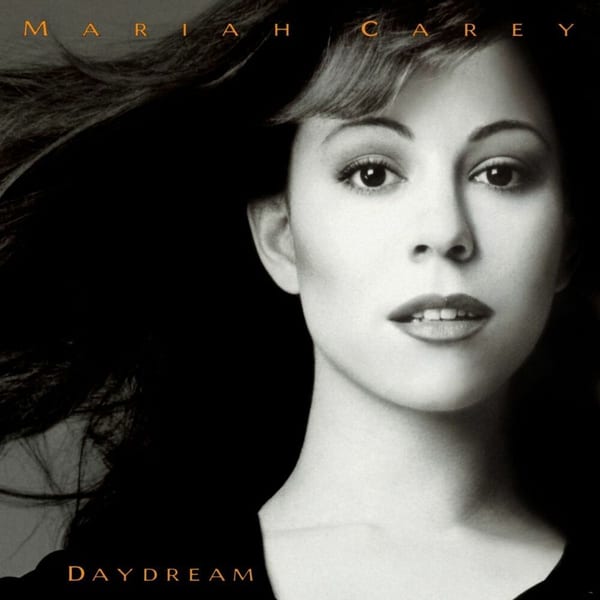
Mariah Carey released two singles a day apart in August 1995. Only one had her name on it
Chick's Someone's Ugly Daughter was cut after midnight at the Hit Factory while Daydream got made in the daytime. On October 30 she was asked about it again. Her answer: #notyet.
Deep DiveRiffiter6 min read
Someone's Ugly Daughter is a 1995 alternative-rock album credited to the band Chick, released by Epic and 550 Music on September 5, 1995. Mariah Carey co-wrote and co-produced it during the Daydream sessions and sang backing vocals as "D. Sue," while her friend Clarissa Dane sang lead after Sony refused to release Carey's own lead vocals. Carey revealed her role in her 2020 memoir; the version with her lead vocals has still not been released.
On August 22, 1995, a single called "Malibu" went out to alternative radio. It was credited to Chick, a band nobody had heard of, and it went nowhere. The next day Columbia released "Fantasy," the lead single from Mariah Carey's Daydream. "Fantasy" became the first single by a woman to debut at No. 1 on the Hot 100, and it stayed there for eight weeks.
Both songs were hers. She co-wrote and co-produced both and sang on both, although on "Malibu" you'd have to know where to listen. The lead vocal belongs to her friend Clarissa Dane. Carey is in the backing stack, credited as "D. Sue."
That's the story of Someone's Ugly Daughter in two dates, and it has been told plenty since Carey owned up to it in her 2020 memoir. What the retellings skip is how that summer actually worked. Carey pushed against her label twice in 1995. One push got through and changed what a pop remix could be. The other got her voice taken off her own record. Which music was better had nothing to do with it.
The night shift
Daydream was recorded at the Hit Factory in Manhattan, and after the day's work, around midnight, a good part of the same crew stayed on. Walter Afanasieff, her co-producer, played drums under the name "W. Vlad." Gary Cirimelli, who did programming on her albums, played guitar as "W. Chester." Dana Jon Chappelle engineered, and he later told Rolling Stone the sessions ran for two or three months, with songs written in ten or fifteen minutes and backing vocals sung by whoever happened to be in the building. He named Sleater-Kinney, L7 and Green Day's Dookie as touchstones.
She called the band Eel Tree. In the memoir she describes the project as "an alter-ego artist and her Ziggy Stardust-like spoof band," and elsewhere she gets less cute about it: "I was exploring my musical range, but I was also filled with rage." I believe both. Plenty of good rock records are jokes their makers meant completely.
Why one push got through
In 1995 Carey was married to Tommy Mottola, the head of Sony Music, the company that owned both Columbia and Epic. She has been blunt since about how the Chick record died. "That got stifled by certain people at the label, so I kind of had to abandon the project," she told Stephen Colbert in 2020. Sony would put the album out, but not with her singing lead. According to Afanasieff, the label also renamed the band Chick and had the more explicit lyrics cleaned up. Dane, who co-wrote every original song on the record, re-sang the leads.
That same summer she was fighting over a remix. For the Bad Boy remix of "Fantasy," made with Sean Combs, she brought in Ol' Dirty Bastard, and Carey has said people at the label laughed at her when she played it for them. The remix survived, and I think the reason is simple: it could still be sold as Mariah. ODB on a Mariah Carey single was strange, but it was a Mariah Carey single, with her voice on top and the hit underneath. A Mariah Carey grunge album came with no such cover story. It asked the biggest-selling woman at Sony to be somebody else for 36 minutes, and the company wasn't going to let her try.
The Fantasy EP collects the ODB version and the Bad Boy mixes. Play it back to back with "Malibu" and you're hearing the same writer test the same fence from two sides in the same month.
What's on the record
Someone's Ugly Daughter came out on September 5, 1995, on Epic and 550 Music: eleven songs in 36 and a half minutes, nothing longer than four and a half, and one cover, Cheap Trick's "Surrender." The sleeve is lipstick lettering over a photo of a cockroach. "I didn't draw the roach," she told Jimmy Fallon. "The roach is real." Billboard's Larry Flick called "Malibu" "cooler than Barbie." Radio didn't agree, and the album sank.
Judge it as what it is: a short, scrappy mid-90s alt-rock record (Consequence heard Hole and Veruca Salt in the songs she previewed last year), sung by somebody other than the person who wrote the melodies. The writing is hers. The voice people want to hear isn't on it. That's why copies reportedly sold for as much as $800 after the memoir came out, and it's why the record still isn't on streaming services. The demand was never really for the 1995 version. If the Hole and Sleater-Kinney end of that decade is your thing, they're both in our female rage guide, and the wider genre is on the grunge page.
Free the grunge
In December 2020 Carey said she'd found the version with her own lead vocals and was still hunting for the original board mixes. Then nothing for years. In September 2025, while promoting Here for It All, she played "Hermit" and "Love Is a Scam" during a conversation with SZA, let Fallon play part of "Prom Queen" on The Tonight Show, and admitted she didn't know which label owned the masters. Questlove, sitting in with the Roots: "Yo, it's her best record." SZA's comment on Instagram was three words long: "FREE THE GRUNGE !!!"
At the MusiCares gala on January 30, where she was named Person of the Year, Foo Fighters and Taylor Momsen played two songs from the record. Reports disagree on the second one; everybody agrees "Love Is a Scam" was on the setlist. Then on October 30, in a Reddit AMA for Glitter's 25th anniversary, somebody asked again. "I get asked this about once a week," she wrote, and then: "#notyet (this is a hint!)".
The filing problem
Say it comes out. What is it?
Most catalogs, ours included, treat a reissue as the same album: a deluxe or a remaster folds into the original page and shares its ratings. That rule breaks here. A Mariah-lead Someone's Ugly Daughter would have the same songs, the same band and probably the same mixes underneath, and a different lead singer, which is the entire reason anyone wants it. Fold it into the 1995 page and thirty years of opinions about Clarissa Dane's record get mixed with first impressions of Mariah's. Credit the 1995 page to Carey and you erase the woman who actually sang the version that came out.
My view is that they're two albums. The 1995 record should keep its page, its credits and its ratings, Dane on lead and D. Sue in the back. The restored one should get its own, filed as Chick with Carey singing. They're different performances of the same songs, the way a live album is, and if it ever lands it belongs with the records in our arrived-late guide rather than in a reissue footnote.
The Rarities, the vault album she put out alongside the memoir in 2020, didn't include any of it. The closer thing to a sequel is Butterfly, the album she made in 1997 as she was leaving the marriage. There's no grunge on it, but it's the first record where she sounds like the one deciding what a Mariah Carey album gets to be.
If you've got the 1995 original, tell us in the comments whether it holds up once you set the backstory aside. And if the Mariah version drops, how are you rating it: as a 1995 album or as a new one?
Discussion
Disagree? Have a better record in mind? Say it — top takes rise.
Sign in to join the discussion.
No one's weighed in yet. Go first.