Austin's New Sincerity got the MTV special. The guy handing out tapes at McDonald's got the future
RateYourMusic has just given the mid-80s Austin scene its own page. The bands it was named for mostly lost. The one nobody signed is why anyone still looks.
EssayRiffiter6 min read
New Sincerity was a loose group of Austin, Texas bands active roughly from 1985 to 1990, including the Reivers (first called Zeitgeist), True Believers, Glass Eye, Wild Seeds and Doctors' Mob, with Daniel Johnston on the scene's edge. The name began as an offhand remark by Austin musician Jesse Sublett to music writer Margaret Moser, and the scene got a 1985 MTV Cutting Edge special and a 1986 Spin feature before fading without a commercial hit. RateYourMusic added Austin New Sincerity as a scene on September 17, 2026.
On September 17, RateYourMusic quietly added a new scene to its genre tree: Austin New Sincerity. That puts a label on a handful of Texas bands from the mid-1980s that most people under fifty have never heard of, and one songwriter everybody has, even if they never connected him to the others.
The page is overdue, and the timing is funny. For a couple of years in the mid-80s these bands were supposed to be the next big thing. MTV gave them an hour, Spin gave them a feature and two major labels wrote checks. Almost none of it worked. The act from that scene with a real afterlife is the one the labels ignored at the time: a young man who came to town with a traveling carnival, took a job at McDonald's and gave his cassettes to anyone who would take one.
A name nobody meant as praise
The phrase started as a shrug. Jesse Sublett, who played in the Austin punk band the Skunks, made a remark about the new bands to his friend Margaret Moser, a local music writer. In the version Barry Shank reports, Sublett said "All those new sincerity bands, they're crap." Sublett remembers it differently: "It's all new sincerity to me... It's not my cup of tea." Either way, Moser put it in print and the bands wore it happily.
What it described was a reaction. Punk and new wave had made a style out of irony and sneering, and these bands liked the Byrds, R.E.M., Hüsker Dü and Roky Erickson and didn't mind showing it. Michael Corcoran's 1986 Spin piece on the scene places it at the Beach Cabaret, a club with open booking, where bands could play before they were any good and get good in public. If you know our jangle canon, you know roughly what the guitars sounded like. The difference in Austin was an extra layer of Texas twang and a lot less polish.
What the hype bought
In 1985 I.R.S. Records filmed an Austin special for its MTV show The Cutting Edge. That is about as much exposure as a regional scene could get in 1985, and for a moment the labels came shopping.
Zeitgeist got the best of it. John Croslin and Kim Longacre traded vocals over chiming guitars, and their 1985 album on DB Records is the scene's most complete record.
Capitol signed them. Then, in 1987, a Minnesota choral group that already owned the name Zeitgeist told them to stop using it. They became the Reivers, after the Faulkner novel, and lost most of their momentum in the switch. Saturday, produced by Don Dixon for Capitol, is a fine record under a name nobody knew.
Four albums, good reviews, no hit, split in 1991. Croslin went on to produce records for Spoon and Guided by Voices, which counts as a small victory: the Austin band that finally broke out nationally had someone from this scene at the desk early on.
True Believers had it worse. Alejandro and Javier Escovedo and Jon Dee Graham drew big crowds on the Texas club circuit and were touring with Los Lobos by 1984. Their 1986 debut, cut with Jim Dickinson in under a week for less than $10,000, never caught what they did on stage. EMI America paid for a second album. Soon after it was finished, EMI America was folded into Manhattan Records and the record was dropped from the schedule. It sat unreleased until Rykodisc put it out as part of the Hard Road compilation in 1994, by which time the band had been gone for years.
Wild Seeds, Michael Hall's band, are the scene's best-kept secret. Mud, Lies and Shame came out on Passport in 1988, a year before they broke up, and it has more good songs than its reputation allows for.
The man on the edge of the frame
Corcoran's Spin piece has a line about Daniel Johnston that has aged better than the rest of the article. He was, Corcoran wrote, "the only person to perform on MTV (as part of 'The Cutting Edge's' recent Austin special) while still working at McDonald's."
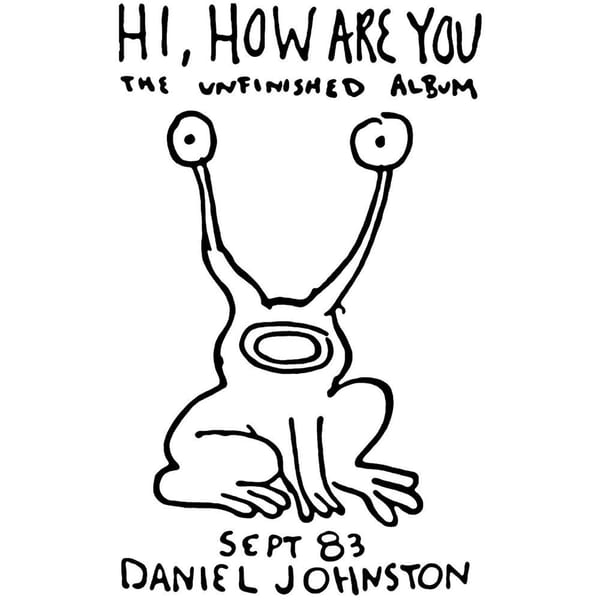
Hi, How Are You was a 1983 home-recorded cassette with a frog Johnston drew on the cover. There was no label and no producer, and there was nothing between the songs and the listener at all. He handed copies out for free. His first public show was as an opening act for Glass Eye. He was in the scene without ever quite being part of it.
The signed bands spent the late 80s trying to make records that sounded like their live shows with budgets that never quite stretched. Johnston had no budget and so no gap to close. His records sounded exactly like he did. When Kurt Cobain started wearing a Hi, How Are You T-shirt in 1992, the frog went around the world, and Atlantic signed Johnston in 1994. The frog is still painted on a wall on Guadalupe Street. Johnston died in 2019.
It is tempting to read this as a morality tale: sincerity for real beats sincerity as a marketing term. It is closer to a story about format. The bands in the Spin feature needed their scene to become a sound that could be sold nationally. Johnston only needed one stranger at a time.
The best New Sincerity record came out in 1994
Here is the claim RYM's new scene page should have to reckon with. The finest album with a claim to the tag was released after the scene had died, by one of its survivors, and every song on it was written by someone else.
Kathy McCarty sang and played guitar in Glass Eye, the scene's arty, dissonant outlier. She first heard Johnston when he opened for Glass Eye in 1985. In 1994 Bar/None released Dead Dog's Eyeball, nineteen Daniel Johnston songs produced by McCarty and her Glass Eye bandmate Brian Beattie.
It does what the major-label records never managed. It takes the scene's belief in plain, unguarded feeling and gives it real arrangements without sanding anything off. Beattie plays half the instruments you can name; McCarty sings as though every line matters, because in Johnston's songs every line does. If you only know these songs from Johnston's own tapes, this is the version where you notice how well they are built.
What the page should hold
Music writers later took the phrase "new sincerity" and hung it on Arcade Fire, Sufjan Stevens, Neutral Milk Hotel and half the 2000s indie shelf. That use has almost nothing to do with Austin in 1985, and it makes the original harder to find. A scene page that pulls the name back to Texas is useful for that reason alone.
The city's next wave was already forming as this one ended. Stars of the Lid started in Austin in 1993 and ended up on a Chicago label, which we cover in our new Kranky Records guide. And if you want the other American scene from those years that treated amateurism as a principle and did better out of it, the Olympia guide makes a good companion.
The five records above are all rateable here. Start with Translate Slowly and Dead Dog's Eyeball and tell us whether we're right that the scene's best record came out after it was over. If you were at the Beach Cabaret in 1985, we especially want to hear from you in the comments.
Discussion
Disagree? Have a better record in mind? Say it — top takes rise.
Sign in to join the discussion.
No one's weighed in yet. Go first.