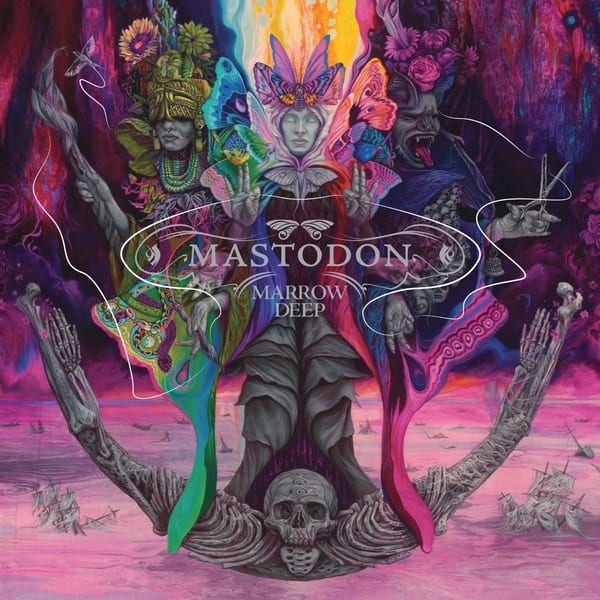
Mastodon lost one voice and hired five: Marrow Deep and the hole where Brent Hinds was
Their first record without a founding member is also the most crowded thing they have ever made. That is not an accident.
EssayRiffiter5 min read
Marrow Deep, released 28 August 2026 on Loma Vista, is the first Mastodon album made without founding guitarist Brent Hinds, who left the band in March 2025 and died in a motorcycle crash that August. The band began recording a week after his death, as a five-piece with a new guitarist and a keyboard player, and brought in five guest vocalists plus two producers: Converge's Kurt Ballou and the Swedish pop writer Patrik Berger.
Mastodon never had a frontman. They had a drummer who sang, a bassist who sang, and a guitarist from Alabama who sang like he was being dragged somewhere against his will. Brent Hinds was the third of those voices and the least predictable part of the band, which is a polite way of describing the last decade of their working relationship.
He left in March 2025. The announcement called it mutual. Hinds, a few months later and shortly before he died, said he had been kicked out. On 20 August 2025 he was killed on his motorcycle in Atlanta, at 51; police found he had been travelling at roughly twice the speed limit and put him at fault. Brann Dailor's mother had died that February. In September, one week after Hinds' death, the band went into the studio.
Marrow Deep came out on 28 August 2026 on Loma Vista, their first record for the label and their first in five years. RateYourMusic has spent this week arguing about whether it is the best album of 2026, which is a strange destination for a record made under those conditions. What strikes me about it has less to do with the songs than with the guest list.
The chair nobody sits in
Hinds sang on every Mastodon album from Remission onward. Take him out and you have a band with a vocal gap and no interest in auditioning a replacement for it, so they went and borrowed five voices instead.
Josh Homme sings on "Snakes for Dinner". Randy Blythe and Nate Newton both turn up on "A Vampire's Demeanor". Joe Duplantier sings on "The Vanishing", where Geezer Butler also plays bass, and Neil Fallon takes the closer, "The Three Fates". That is five guest vocalists across twelve songs on a record by a band who used to handle all of it in-house.
You can read this as a wake with a good address book. I read it as a group who could not stand the silence in the space where the third voice used to be, and filled it with anyone they trusted. Nick Johnston plays the guitar parts and by every account plays them well; nobody asked him to be the third singer, because that job was never advertised.
Three-fifths of Converge made this record
The production credit is where it gets genuinely odd. Marrow Deep was produced by Kurt Ballou and Patrik Berger, and I still can't quite believe those two names sit on the same sleeve. Ballou is Converge's guitarist and the engineer behind a couple of decades of American hardcore at GodCity. Berger is the Swedish writer and producer whose credits include Robyn's "Dancing On My Own" and Charli XCX's "Boom Clap".
Then look further down the credits: Ben Koller, Converge's drummer, plays percussion on the opening track. Nate Newton, Converge's bassist, sings on "A Vampire's Demeanor". Three-fifths of Converge worked on a Mastodon album, and nobody made a fuss about it.
Converge, for what it's worth, are the other band in this story with an album everybody names and an album they should. Jane Doe takes all the attention; You Fail Me is the one Ballou cared about enough to remix from scratch twelve years later. It's number fifteen in the wrong album won, if you want to argue about that separately.
The new members are barely in the songwriting
Here's the detail that says the most about where the band's head was. Of the twelve songs, eight are credited to Dailor, Bill Kelliher and Troy Sanders alone. Johnston has a co-write on four. Nogueira has three, all of them shared with Johnston, and one of those is the seven-and-a-half-minute closer.
So the new members were in the room, and mostly not in the writing. The three men who had just lost a friend they were no longer speaking to wrote this by themselves. Troy Sanders has said the plan was to have all five of them present in the studio at once; they started from more than thirty demos and cut it to twelve. The five-piece is real. The authorship is still the founding three, closed ranks and all.
The second grief record in a row
This is not the first time. Hushed and Grim (2021) was a double album made in the shadow of Nick John, their manager and friend, who died in 2018. That record was long, slow and unresolved in a way people found hard to sit through.
Marrow Deep runs 65 minutes over twelve songs, which is tighter, and Dailor has explained the title as the deepest level a relationship can reach, pointed at both his mother and Hinds. In July the band put out a 35-minute film, The Mastodon in the Room, in which the three of them sit in an Atlanta theatre watching old footage of themselves and talk about the years before Hinds left with a candour no press release ever had: the drinking, and the shows that came apart because of it. They released the confession first and the album second. That order matters. By the time the record arrived, nobody could pretend this was a straightforward tribute.
Where it lands
The Mastodon canon has been settled for a while, and it's wrong in the usual way. Leviathan is the record with the myth: the Moby-Dick album, Relapse, 2004, the one that always gets named.
Crack the Skye, from 2009, is the better album and the one that dared more, and it came out of a real death: Dailor's sister Skye, who took her own life at 14.
Grief has been the engine of this band's best work for a long time, which is bleak but true. What is new on Marrow Deep is that the person being mourned is also the person they fired, and there is no clean way to write that song. So they wrote around it, twelve times, with the help of everyone they could get on the phone.
I don't think it's the album of the year. I think it's the most complicated record Mastodon have ever had to make, and they got it out. Rate it, tell me I'm wrong about Leviathan, and take the Converge argument downstairs to the comments.
Discussion
Disagree? Have a better record in mind? Say it — top takes rise.
Sign in to join the discussion.
No one's weighed in yet. Go first.