Blog/Field Guide
What is shoegaze? The insult, the pedals, and why it refuses to stay dead
A word coined to mock four bands in Camden now describes half of TikTok. Here's what it actually means.
Riffiter7 min read
Shoegaze is a style of British guitar music that emerged around 1989–1991, built on heavily effected guitars, buried vocals and volume used as an arrangement tool. The name began as press mockery in 1991, the original scene was over by 1996, and the genre has since been revived twice: by 2000s nu gaze and blackgaze, and again by a generation of internet-native artists in the 2020s.
The word is doing a lot of work these days. It gets attached to a Deafheaven record, a 1998 Duster album that isn't really shoegaze, a hyperpop producer's reverb setting, and roughly nine million TikToks. Somewhere under all of that is a genre with a real definition and a five-year window, plus an origin story much less romantic than the music.
Start with the insult.
The name was a put-down
In March 1991, Andy Ross of Food Records went to see Lush at the Venue in New Cross. Moose were also on the bill, and their singer Russell Yates spent the set staring at the floor. He was reading lyrics he'd taped down there. Ross called them shoegazers and the joke got out.
The earliest print sighting anyone has pinned down is the NME of May 25, 1991, where Steve Lamacq announced a Slowdive EP and called them "shoe-gazers." Two weeks later, on June 8, Melody Maker's Steve Sutherland reviewed Moose at the Camden Underworld and noticed that the audience was mostly other bands: Damon Albarn, Miki Berenyi from Lush, Mark Gardener from Ride. He called it the scene that celebrates itself. He meant it warmly. The music press spent the next three years using it as a weapon.
So the genre's two most famous names were both coined by people watching the audience rather than listening to the records. That tells you something about how British music writing worked in 1991, and nothing at all about the sound.
What is actually happening in the noise
Here's the working definition: in shoegaze, the guitars stop being instruments playing in a room and become the room.
That's not the same as "loud guitars with pedals." Plenty of bands are loud. The distinguishing move is that the effects chain does harmonic work rather than decorative work. Kevin Shields' glide guitar is the clearest example: he tapes the tremolo arm so it doesn't sit tight against the body, then works it while he strums, so every chord drifts in pitch as it sounds. Run that through a reverse reverb from a Yamaha SPX90 and the attack of the note arrives after the note does. Your brain keeps trying to correct the tuning and can't. That queasy floating quality is the whole trick, and it is a compositional decision, not an effect.
The second marker is where the voice sits. In shoegaze the vocal is mixed level with the guitars or under them, treated as one more layer of the wash. You are not supposed to catch every word. Rachel Goswell and Bilinda Butcher aren't singing lyrics at you so much as adding a human-sounding frequency band.
The ancestor everybody agrees on:
The Jesus and Mary Chain's Psychocandy (1985) put pure feedback over Shangri-Las pop songs and proved the noise could be the point rather than the obstacle. Cocteau Twins got there from the other direction on 4AD, though their records are usually filed as dream pop, and the distinction is worth keeping: dream pop keeps space and clarity, shoegaze fills every gap. If the softer branch is what you want, our dream pop guide starts there.
The window: 1988 to 1993
The core run is short. My Bloody Valentine's Isn't Anything (1988) laid the groundwork. Ride's Nowhere arrived in 1990 on Creation and remains the most physical record the scene produced, all drums and forward motion.
Then November 1991, and the album that ended the argument about how far the technique could go.
Loveless has its own deep dive here, so I'll skip the studio horror stories. What matters for the definition is that it's the record where the guitars fully stopped sounding like guitars and nobody could say what they did sound like instead.
And then the record that most people actually fall in love with:
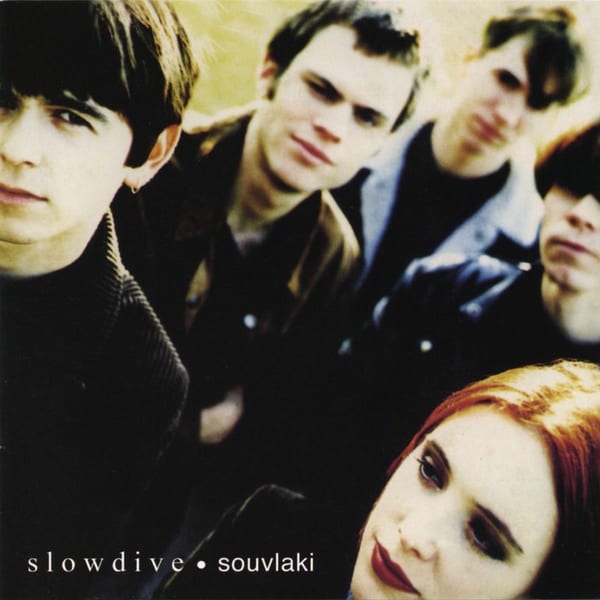
Souvlaki (1993) is Slowdive with pop songs underneath the fog, half of it made while Neil Halstead and Rachel Goswell were breaking up, and two tracks built with Brian Eno. Melody Maker's Dave Simpson wrote that he "would rather drown choking in a bath full of porridge than ever listen to it again." That review has aged into a punchline, but it wasn't unusual. It was the house style by 1993.
Why it died
Grunge got there first: Nevermind came out six weeks before Loveless and made a scene of English kids studying their pedals look like a hobby. Then Britpop arrived with Suede in March 1993 and offered the press what it actually wanted, which was personalities and quotes. NME ran gags about shoegaze bands being posh boarding-school types. Sony bought into Creation in 1992 and the label got interested in acts that sold.
Slowdive were dropped in 1995, a week after Pygmalion, an album so far from anything commercial that the story of it is its own thing. Ride broke up in 1996. Lush ended after drummer Chris Acland died that same year. My Bloody Valentine went quiet for twenty-two years. Five years, done.
Why it came back, twice
The first revival was a slow reassessment. Pitchfork put Loveless near the top of its 1990s list in 2003, Sofia Coppola put Kevin Shields all over Lost in Translation the same year, and MySpace did the rest. M83, the Radio Dept., Asobi Seksu and Deerhunter got called nu gaze. Alcest's Le Secret EP in 2005 welded the guitar sound to black metal and started blackgaze, which peaked with Deafheaven's Sunbather in 2013. Nothing and Title Fight brought it into hardcore.
Streaming did something stranger. A band like Duster, who broke up in 2001 having sold almost nothing, became genuinely popular twenty years later because the algorithm kept feeding them to teenagers alongside Slowdive:
The current wave came from an unexpected place. Zoomergaze, as it got named, mostly arrived through digicore and hyperpop rather than through indie rock. Jane Remover's Frailty (2021) and Quannnic's Kenopsia (2022) are the hinge records; by late 2023 Wisp and flyingfish were going viral on TikTok with guitar tones nobody in Camden would have recognised as related.
julie's my anti-aircraft friend (2024) is the one I'd hand somebody who thinks the revival is all vibes and no songs. If you want the wider map, we've got a canon of the new shoegaze and a ranked run through the classics.
A rough test
When someone asks whether a record counts, I use three checks, and I'll admit up front they're arguable. Is the vocal mixed at or below the level of the guitars? Is the guitar tone doing something to pitch and not just to distortion? Would the song lose its identity played on an acoustic in a quiet room?
Three yeses and it's shoegaze. One or two and you probably have dream pop, or an indie band with a nice reverb pedal, which is fine and also a different thing.
That last check is where most of the current arguments live. Half of what gets tagged shoegaze on streaming is well-recorded indie rock with the reverb up, and half the people insisting on the distinction are being snobs about it. Both can be true.
So: what's the record that made the word click for you, and which supposed shoegaze album do you think doesn't qualify? Rate the ones above and take it to the comments. This is a genre whose fans have been arguing about the boundary since a man made a joke about a singer reading off the floor.
Discussion
Disagree? Have a better record in mind? Say it — top takes rise.
Sign in to join the discussion.
No one's weighed in yet. Go first.