The best albums with chiming guitars, and why they chime
Everyone names the same five records. They are the right five. What nobody explains is that chime is a studio technique, and once you know the recipe you start hearing it a long way outside indie rock.
Field GuideRiffiter5 min read
Chiming guitar tone comes from four ingredients: a clean amp, arpeggios instead of strums, compression that stretches the note's decay, and doubling at the octave. The Beatles' A Hard Day's Night (1964), The Byrds' Mr. Tambourine Man (1965), R.E.M.'s Murmur (1983), The Smiths' The Queen Is Dead (1986) and Cocteau Twins' Blue Bell Knoll (1988) are the canonical records; Television, The Durutti Column and Thomas Mapfumo used the same tone for entirely different ends.
Ask this anywhere and the same five albums come back, usually in the same order. The list is not wrong. It just stops early, because chime is a technique before it is a genre, and once you know what makes a guitar do it you start hearing it in places no jangle list will send you.
Take them in order.
The five everyone names

Rickenbacker built its second electric twelve-string in December 1963 and handed it to George Harrison in a New York hotel that February, the night before the Ed Sullivan broadcast. Five months later the opening chord of "A Hard Day's Night" carried that guitar into every country with a radio. The album leans on it from end to end. Nobody needed the sound explained to them, they just wanted one of whatever made it.
Roger McGuinn saw the film and went and bought the guitar. "Mr. Tambourine Man" was cut at Columbia's Hollywood studio in January 1965 with McGuinn the only Byrd playing on it, and it went to number one in Britain and America both. The telling detail comes a year later: in 1966 he sent the Rickenbacker back to the factory and had a compressor installed inside the instrument. He wanted on stage what the studio had been handing him for free. The chime, in other words, was never only in the wood.
Murmur was recorded between 6 January and 23 February 1983, at Reflection Sound in Charlotte and Drive-In in Winston-Salem, produced by Mitch Easter and Don Dixon. Peter Buck's Twin Reverb had broken, so nearly the whole album went through Easter's 1960s Ampeg Gemini II instead. Every song but "Pilgrimage". The arpeggios belong to Buck. The ring around them belongs to a borrowed amp that happened to be in the room.
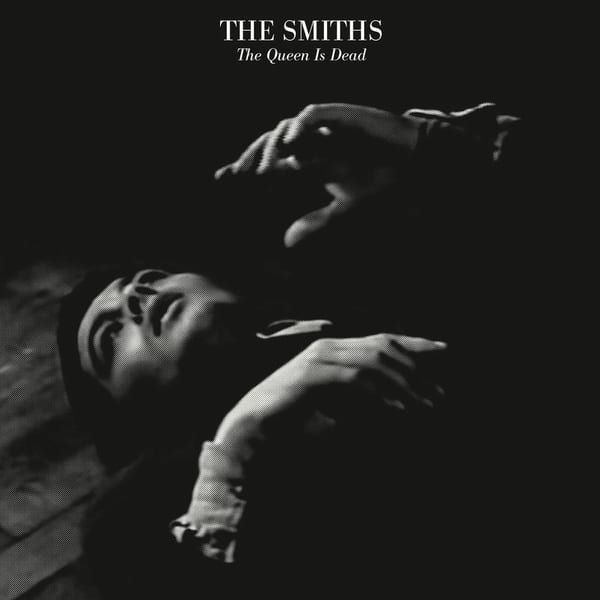
Johnny Marr's Rickenbacker 330 does most of the chiming across The Queen Is Dead, recorded between July and December 1985 at RAK in London, Jacobs in Farnham and Drone in Manchester. The part people skip is how much acoustic guitar sits underneath. "Cemetry Gates" (Morrissey's spelling, and it stuck) is a bright electric line laid over an acoustic strum, which is why it rings instead of jangling. Marr layered obsessively, and layering turns out to be half the recipe.
Blue Bell Knoll arrived on 19 September 1988, the first Cocteau Twins album Capitol put out in the States. Robin Guthrie has said the studio time went into how the guitars were recorded rather than what was being played on them. That is the method stated out loud: treatment first, notes second.
What chime actually is
Four ingredients, and a record needs at least three of them.
A clean amp, because distortion eats the high partials that do the ringing. Arpeggios rather than strummed chords, so single notes get room to decay into one another. Compression, which flattens the attack and stretches the tail until one note is still sounding when the next one lands. And doubling at the octave, which a twelve-string gives you for nothing and which Marr got by stacking takes.
Only one of those four requires a Rickenbacker. That is why the sound keeps escaping the genre it is filed under.
Where the lists stop
The jangle canon treats chime as a synonym for sweetness, and it is not. A clean signal magnifies whatever you put through it, and dread magnifies fine.
Marquee Moon is two clean guitars for forty-five minutes, no distortion anywhere worth mentioning, and it is a tense, unfriendly record. Verlaine and Lloyd use the same undistorted tone the Byrds used and point it at something else entirely. The ten-minute title track keeps ringing right through its own climb.
Vini Reilly built the whole Durutti Column catalogue out of chime and echo, alone, in Manchester, while Factory's other bands were making noise. LC moves like water and never resolves into a pop song. If you want proof that the tone carries no fixed mood, play it straight after Murmur.
The other family tree
Here is the part the lists never reach at all. In Zimbabwe in the 1970s, guitarists spent years working out how to play the mbira, the Shona thumb piano, on an electric guitar. Thomas Mapfumo and Jonah Sithole got it right. Sithole said he started imitating the mbira on guitar with his first single and assumed it could not be done, since the instrument does not lay out like a keyboard.
What they arrived at is interlocking, compressed, arpeggiated, clean and bell-like. It is chime by every definition offered above, arrived at by transcribing a thumb piano rather than by chasing a Beatles record, with no Rickenbacker involved at any point. Two traditions with no contact between them landed on the same acoustics.
Still going
Blue Rev is chime with the guitars turned up loud enough to blur, which is where the sound went after shoegaze got hold of it. The recipe underneath has not changed at all, and the compression is still doing what it did in 1965.
Our jangle canon runs the pop side of this in order, 1965 to now, and the Dunedin sound covers the New Zealand branch, where the same guitars turned up on much worse tape.
Rate the ones you know. If you think there is a better argument for what makes a guitar chime, or a record above that does not belong, the comments are underneath.
Discussion
Disagree? Have a better record in mind? Say it — top takes rise.
Sign in to join the discussion.
No one's weighed in yet. Go first.