Blog/Debate
Trout Mask Replica: masterpiece or hoax?
Half a century of listeners have split over Captain Beefheart's double album. The argument is usually the wrong one.
Riffiter6 min read
Trout Mask Replica (1969) is Captain Beefheart and His Magic Band's double album, produced by Frank Zappa and built from eight months of grueling rehearsal in a rented Los Angeles house. Listeners have argued ever since over whether it is a genuine avant-garde masterpiece or an unlistenable in-joke. It is a masterpiece, and the more interesting fight is over how it got made.
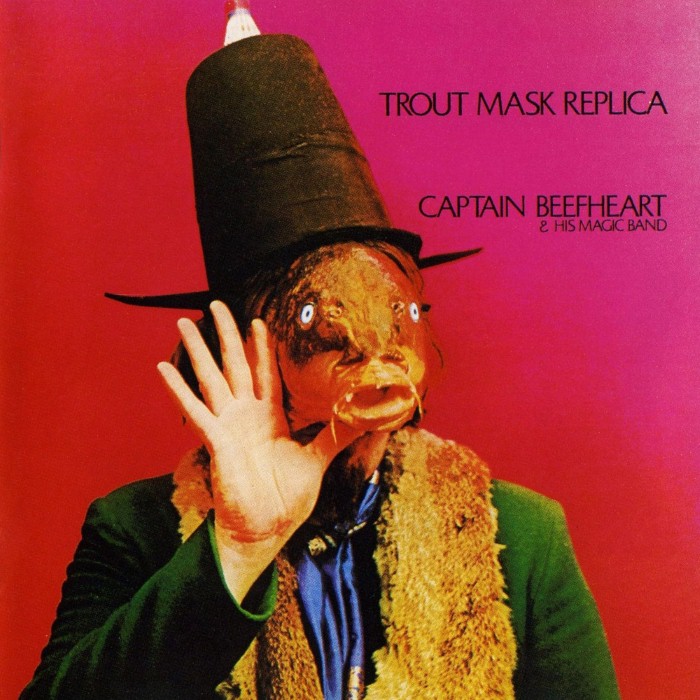
Put on Trout Mask Replica for someone who has never heard it, and you can usually clock their verdict inside ninety seconds. The face does one of two things. It opens, like a door, into delight. Or it closes, slowly, into the polite suspicion that you are pulling some kind of prank.
That split has never closed. More than fifty years after its release, Captain Beefheart's 1969 double album sits near the top of every serious "greatest albums" list and near the top of every "most overrated" thread that answers it. On RateYourMusic it carries a glowing average and a long tail of one-star reviews calling it the emperor's new clothes. Both camps are loud. Both think the other camp is either deaf or lying.
The popular version of that argument is the wrong one, so it's worth having properly.
The case that it's a hoax
Take the skeptics seriously for a second, because the surface evidence is on their side. Twenty-eight tracks of guitars that seem to be playing different songs in different time signatures. A bass that wanders off on its own errand. Don Van Vliet bellowing over the top in a Howlin' Wolf roar that almost never lands on the beat, sometimes reciting nonsense, sometimes muttering about a squid eating dough in a polyethylene bag. There are field recordings, a capella fragments, and a bit where Van Vliet interviews a band member about a "bulb" of fast and bulbous gravy.
If you walked in cold and someone told you four guys made this up on the spot, you would believe it. That is the whole basis of the hoax theory: it sounds random, so it must be random, and a thing that is random can't be good, so anyone praising it is performing.
The trouble is that the premise is false. None of it is random.
Why the music isn't a joke
Here is the fact that ends the hoax argument, even if it doesn't change whether you enjoy the record. Trout Mask Replica is one of the most rigidly composed albums in rock. Van Vliet couldn't really play or notate music, so he hammered the parts out on a piano and whistled them, and drummer John French sat there for months transcribing those bashings into actual guitar and bass lines, then drilling the band until they could play the result in their sleep.
What sounds like chaos is two guitars locked into interlocking patterns that refuse to resolve, riding a drum part that holds the whole contraption in tension. Listen to "Moonlight on Vermont" or "Pachuco Cadaver" enough times and the disorientation flips: you start hearing the architecture, the way the parts click against each other on purpose. It is the Delta blues taken apart down to the bolts and welded back together wrong, deliberately, by people who could absolutely have played it right.
The lineage backs this up. Beefheart was not a man who couldn't write a song. He was a man who chose not to, here.
Safe as Milk (1967), two years earlier, is a tight, soulful, almost radio-friendly blues-rock record with a teenage Ry Cooder on guitar. The voice is already extraordinary. The songs are conventional and excellent.
And Clear Spot (1972), three years later, is funky, warm, and full of things you could call hits, including a genuine ballad in "Too Much Time." Van Vliet had range. Trout Mask is what happened when he aimed all of it at one impossible target.
Even Lick My Decals Off, Baby (1970), the follow-up he reportedly considered his best, refines the Trout Mask method rather than retreating from it. This was a direction, pursued on purpose, by a band that knew exactly what it was doing.
The actual con
So the music isn't the hoax. But there is a con buried in this record, and it's the one the masterpiece-versus-prank framing keeps everyone from seeing.
The con is the myth of how it was made. Van Vliet liked to tell interviewers that he composed the whole thing in a few hours, that he taught his musicians everything in an afternoon, that it all poured out of him in a burst of pure spontaneous genius. It's a great story. It's also close to the opposite of the truth, and it erased the people who did the work.
The band lived together in a small rented house for those eight months, in conditions that several of them later described as cult-like: near-total poverty, sleep deprivation, marathon "talk" sessions where Van Vliet would psychologically break a member down in front of the others. John French, who transcribed and arranged most of the album, was left off the credits entirely. He didn't get his due until he wrote it all down in a memoir decades later. There's a famous detail that doubles as a metaphor: Van Vliet cut most of his vocals without monitoring the band through headphones, singing along to the bleed coming through the studio door, which is part of why his voice seems to drift free of the music's meter. The genius was real. So was the cost, and most of the cost was paid by other people.
So, masterpiece or hoax?
Masterpiece. This isn't close. John Peel called it the one record in popular music that an outsider from the fine arts could recognize as a work of art, and the Library of Congress put it in the National Recording Registry in 2010. Half the interesting guitar music of the last fifty years runs through it. You can hear its detuned, interlocking attack in what Sonic Youth and the Minutemen later did on SST, mapped in our SST Records guide, and you can hear its "rebuild rock from zero" nerve echoing through the German bands in our krautrock guide.
If you bounce off the 1969 album, Doc at the Radar Station (1980) is the late-career version of the same ideas with a cleaner recording and a little more daylight, and it's a fair place to find your footing.
But the honest answer keeps a wrinkle in it. The hoax was never the music. The hoax was the story of effortless genius wrapped around it, and the price a few young musicians paid so one man could tell that story. Knowing that doesn't make the record worse. It just makes "is it a joke?" the wrong question, when "what did it cost, and does that change how I hear it?" is the one actually worth arguing about.
So argue. Rate it below, one star or five, and tell us which face you made the first time you heard it.
Discussion
Disagree? Have a better record in mind? Say it — top takes rise.
Sign in to join the discussion.
No one's weighed in yet. Go first.