Ambient country: the Western where almost nothing moves
Pedal steel, empty space and the long road from Bruce Langhorne to SUSS.
Field GuideRiffiter5 min read
Ambient country, also called ambient Americana or cosmic pastoral, joins pedal steel and roots instrumentation to drone, field recording and slow-moving electronic music. Its lineage runs from Bruce Langhorne and Brian Eno to Earth, Chuck Johnson, William Tyler, SUSS and North Americans.
Country music is usually built around a voice and a clock. Ambient music can do without either. Put the two together and the first thing to disappear is the campfire story. What remains is the scrape of a string, a pedal steel note hanging past its natural life, and a large amount of weather.
That loose family of records now goes by ambient country, ambient Americana or cosmic pastoral. The names are recent; the sound is not. In 2026, Uncut traced a renewed wave running through SUSS, North Americans, Luke Schneider and other artists who use rural instruments without pretending to live in an old photograph. A recent r/ambientmusic thread asking for more music like SUSS and North Americans pulled many of the same names into one place: Chuck Johnson, William Tyler, Hayden Pedigo, Pan-American, Earth and Bruce Langhorne. The audience already hears a genre, even if the records keep slipping around its edges.
The soundtrack that arrived before the genre
Bruce Langhorne's score for Peter Fonda's 1971 film The Hired Hand is the useful starting point. Langhorne took a black-and-white copy of the film home to Laurel Canyon and played along while Natalie Mucyn recorded him on a Revox reel-to-reel. He overdubbed Farfisa organ, banjo, fiddle, harmonica and other instruments around a 1920 Martin guitar. The result is sparse, handmade and oddly detached from the Western it accompanies.
The score did not receive a proper soundtrack release at the time. That accident helped it travel like a rumor until a 2005 CD and later vinyl editions gave it an afterlife. Its importance is not that it invented a rulebook. It proved that Western instrumentation could describe empty space instead of filling it.
Ry Cooder's score for Wim Wenders's Paris, Texas found a different route through the same country. Cooder's slide guitar follows the desert rather than decorating it, with Blind Willie Johnson's "Dark Was the Night, Cold Was the Ground" somewhere in its ancestry. The film came out in 1984; the soundtrack album followed in 1985.
Pedal steel leaves Earth
Brian Eno, Daniel Lanois and Roger Eno made Apollo: Atmospheres and Soundtracks for footage of the Apollo missions. The record came out on EG in 1983, years before the documentary settled into its final form as For All Mankind. Eno's smart move was to connect American space travel to American frontier music. Lanois plays pedal steel on the country-facing pieces, including "Deep Blue Day," and the instrument sounds perfectly at home in zero gravity.
The familiar reading of Apollo treats its country touches as a clever contrast with the synthesizers. Listen again and the steel is carrying the emotional argument. Electronic tones can make space vast; Lanois makes it lonely. That idea kept turning up in his own work. Belladonna, released by Anti in 2005, places his pedal steel beside pianist Brad Mehldau and drummer Brian Blade. It is not a country album in any Nashville sense, but it understands how one bent note can imply a whole horizon.
When drone metal found a road
Earth began as a band of volume and duration. On Hex; Or Printing in the Infernal Method, Dylan Carlson kept the duration and lowered the temperature. Southern Lord released the album in 2005; Randall Dunn produced it, with Adrienne Davies on percussion and Dan Tyack adding lap and pedal steel. Carlson's song titles pull phrases from Cormac McCarthy's Blood Meridian, but the record refuses the cheap violence that many McCarthy-inspired projects chase.
The guitars advance at walking speed. Davies marks time without turning it into a march. This is where ambient country gets darker than New Age and less picturesque than Americana: the open space can contain dread. If the American frontier is one of the country's favorite myths, Hex asks what the myth had to bury before anyone could admire the view.
A scene appears in the 2010s
Chuck Johnson's Balsams is one of the records that made the current vocabulary stick. Released in 2017 on VDSQ, it was Johnson's pedal steel debut. He recorded the material in a two-week session in late 2015, then arranged and treated it the following spring. The notes bloom slowly, but they are not formless. Johnson plays the steel like an organ that still remembers wood and wire.
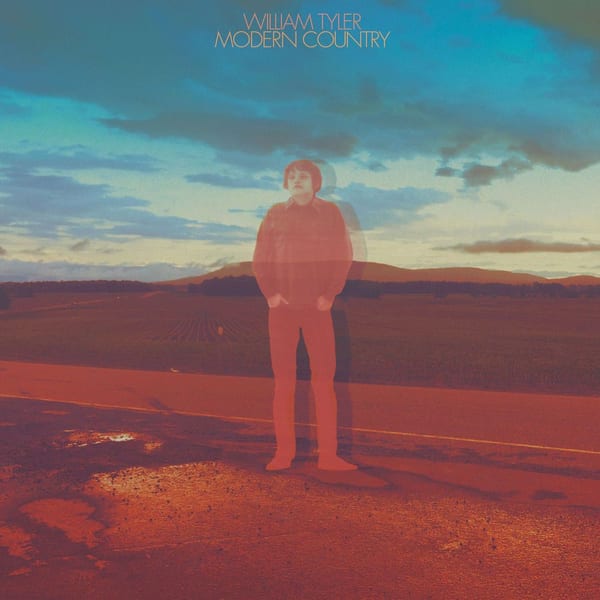
William Tyler's Modern Country arrived a year earlier on Merge. Tyler wrote much of it during a stay near William Faulkner's house in Oxford, Mississippi, then recorded at April Base in Wisconsin with Phil Cook, Darin Gray and Glenn Kotche. The title sounds like a genre claim, but Tyler was writing about a vanishing America of back roads and AM radio. His clean guitar lines give the record direction while the band keeps questioning where that direction leads.
The American primitive guitar guide follows one branch of Tyler's family tree; our ambient albums guide follows another. Ambient country lives in the argument between them.
By 2019, SUSS were calling themselves an ambient country group without flinching. High Line used acoustic guitar, pedal steel, harmonica and mandolin beside synthesized processing. North Americans' Roped In followed in 2020 with Patrick McDermott's guitar, Barry Walker's pedal steel, guest guitar from William Tyler and harp from Mary Lattimore. These records do not sound identical. The shared trait is restraint: each instrument leaves enough room for the next one to become a place rather than a part.
What belongs here, and what does not
Pedal steel alone does not make ambient country. Plenty of country records use it as punctuation; plenty of ambient records borrow a twang for local color. The stronger records let roots instruments change the scale of the music. A guitar can suggest a road without playing a traveling song. A drone can hold still while the imagined landscape moves behind it.
That is why the genre can stretch from Langhorne's homemade soundtrack to Earth's post-metal and SUSS's New York studio constructions. It is also why the phrase may eventually become annoying. Good genre names help listeners find the records, then get out of the way.
Start with The Hired Hand if you want the source, Apollo if you want the bridge, Hex if you want the threat, and Modern Country if you want the modern center. Rate the records as you go, then argue for the missing name in the comments. This small genre is still being assembled by recommendations.
Discussion
Disagree? Have a better record in mind? Say it — top takes rise.
Sign in to join the discussion.
No one's weighed in yet. Go first.