Blog/Deep Dive
World of Echo at 40: Arthur Russell left a thousand tapes and one finished record
He revised everything forever and released almost nothing. The one album he let go of is the one where the revising became the music.
Riffiter5 min read
World of Echo (1986) was the last album Arthur Russell released in his lifetime: his cello, his voice and a wall of echo, recorded between 1984 and 1986 and issued by Upside in the US. Russell died of AIDS-related illness in 1992, aged 40, leaving over 1,000 tapes behind, roughly 40 of them different mixes of a single song. Four decades on, the archive built from those tapes has produced more Arthur Russell albums than he ever approved himself.
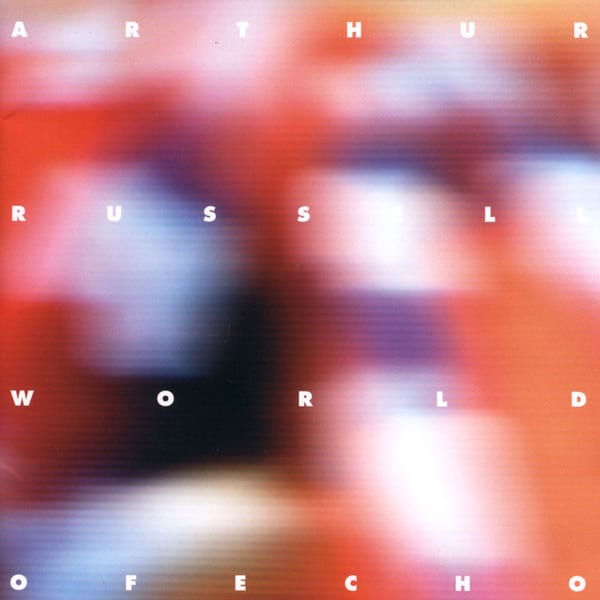
Arthur Russell made about forty different mixes of one song. Not forty takes. Forty mixes, of one song, kept and labelled and filed. He died in 1992 with more than a thousand tapes in storage and almost nothing on them finished, because finishing was the part he couldn't do.
Which is what makes World of Echo strange. It's a completed record by a man who did not complete records.
It came out in 1986 on Upside, a small American label, and reached the UK through Rough Trade in March 1987. It was the last album he released while he was alive. The instrument list: a cello, a voice, some hand percussion, delay.
Oskaloosa to the Kitchen
Russell was born in Oskaloosa, Iowa, in 1951, which is the least likely origin story in downtown New York. He learned cello as a child, left at eighteen for a Buddhist commune in San Francisco, studied North Indian classical music at the Ali Akbar College of Music and Western composition at the San Francisco Conservatory, then landed in New York in 1973 and enrolled at the Manhattan School of Music while sitting in on classes at Columbia.
By autumn 1974 he was musical director of The Kitchen, the avant-garde venue downtown, a job he kept for less than a year. He booked Talking Heads. He worked with Allen Ginsberg, with the trombonist Peter Zummo, with Peter Gordon. And then, around 1976, he found disco, and did what genuine obsessives do: took it exactly as seriously as the composition.
24→24 Music (1982), released as Dinosaur L, is Russell making dance music the way a conservatory dropout makes dance music. It runs long. Sections refuse to resolve. The groove keeps getting interrupted by its own author. He worked with the DJ Walter Gibbons, and in 1981 co-founded Sleeping Bag Records with Will Socolov. In a parallel life he was simply a disco producer, and a good one.
What's actually on it
Phill Niblock invited Russell to play at Experimental Intermedia, his loft. Russell turned up with a cello and a box of effects. That's most of where World of Echo comes from: one man alone in a room, playing into delay, taped.
The cello doesn't behave like a cello. He amplified and distorted it until it edged toward the sound of a guitar. Over the top he sings in a voice that never pushes, a flat Iowa tenor that sounds like someone talking to himself in the next room. Tracks bleed into one another. Nothing announces itself. There is no rhythm section, which from a man who'd spent five years making people dance is a decision worth sitting with.
Dub, learned secondhand
The echo isn't decoration. Russell took the idea from dub records, from the Jamaican engineers who had worked out a decade earlier that you could take a performance and make the space around it the subject. If that lineage is new to you, we mapped it this week in eighteen dub records where the engineer became the author.
What he did with the technique was contrary. Dub subtracts the singer. Russell had no band to subtract from, so he turned it on himself: play a phrase, let the delay answer it, play against the answer. Dub for one person. Nobody else was doing this, largely because nobody else was both a Kingston obsessive and a cellist.
At the time it went over badly. Andy Gill, writing in Q, filed Russell as "just another art bore." David Stubbs heard it correctly and called it "a fuzz, a blur, a rich, throbbing pulse." You can guess which review the record outlived. Fact named it the best album of the 1980s in 2013; Pitchfork placed it 25th for the decade in 2018.
The thousand tapes
Russell died on 4 April 1992, of AIDS-related illness. He was 40.
Then the excavation began. Point Music, the label Philip Glass co-founded, released Another Thought in 1994, assembled from unreleased tapes.
In 2004 Steve Knutson founded Audika specifically to work the archive, alongside Tom Lee, Russell's partner. The releases have not stopped since.
Calling Out of Context (2004) is the one that broke him to a new generation: pop songs, more or less, that he had sat on for two decades. Then came Springfield, First Thought Best Thought, Love Is Overtaking Me, Corn, Iowa Dream in 2019, Picture of Bunny Rabbit in 2023. There are now more posthumous Arthur Russell albums than ones he signed off on.
I don't think this is grave-robbing. Knutson has said he won't market the music, on the grounds that marketing a dead man is crass, and the work has been done with the estate rather than around it. Love Is Overtaking Me on its own justifies the whole operation: it turned out there was a country songwriter in there that nobody knew about.
But there's a tension in it that nobody can resolve, and it's worth naming out loud. Russell made forty mixes of a song because he didn't believe any one of them was the song. Every posthumous release has to pick one. Somebody sits in a storage unit in Queens, listens to forty versions, and chooses. Choosing is the precise act Russell spent his life refusing to perform.
The archive has now circled back onto World of Echo itself. Sketches For World of Echo collects a June 1984 performance at Niblock's loft: raw material for the one record he did finish. We're being handed the drafts of the only thing he ever let go of.
Forty years on
Here's where I keep landing. World of Echo works because it doesn't sound finished. It sounds like a man in the middle of thinking, and the delay is the thinking. Every phrase gets answered by its own ghost half a second later, Russell plays against the ghost, and the piece wanders somewhere neither of them planned. It isn't a record about revision. It's revision, taped, and then, very much against his habits, allowed to leave the building.
He never did it again. He didn't get the chance.
Forty years on it's the one everybody names, and for once the consensus is right. Rate it below. And if you've worked through the posthumous stack, tell me where you come down on the archive: gift, or overreach? I've argued myself onto both sides of that and I'm not confident either way.
Discussion
Disagree? Have a better record in mind? Say it — top takes rise.
Sign in to join the discussion.
No one's weighed in yet. Go first.