Blog/Deep Dive
The Eraser at 20: the laptop record that let Thom Yorke stop being Radiohead
Twenty years ago today, the frontman of the world's most scrutinized band put out nine electronic sketches under his own name and quietly changed what came next.
Riffiter4 min read
The Eraser is Thom Yorke's debut solo album, released on 10 July 2006 through XL Recordings and produced by Nigel Godrich. Built largely on a laptop during a Radiohead break, its glitchy electronics and piano fragments reshaped Yorke's later work and named the band he would form to play it live, Atoms for Peace.
Twenty years ago today, on 10 July 2006, Thom Yorke put out a record that was supposed to mean nothing and ended up meaning a lot. The Eraser arrived on XL Recordings with a warning label attached, more or less: Yorke insisted, loudly, that it was not a Radiohead split and not a big deal. A few laptop sketches he'd made on the side. Move along.
Nobody believed him, and they were right not to.
A side project that wasn't
Here's the context that makes the record legible. Radiohead spent 2004 and 2005 stalled. They'd left EMI, had no label, and were circling the songs that would become In Rainbows without cracking them. Yorke, restless, started assembling fragments on his own: piano loops chopped up, drum machines, his voice cut into pieces and reassembled with the patience of a glitch record. Nigel Godrich, the band's sixth-member producer, told him to stop hiding behind the machines and actually sing on them.
The result is the most Thom Yorke thing imaginable and also unlike anything Radiohead had released. Where Kid A buried the human in the electronics as a statement, The Eraser just sounds like one anxious man and a computer at 3am.
It's a small record on purpose. Nine songs, most of them built from two or three ideas circling each other, mixed so close you can hear the seams. That intimacy is the whole point. This is Yorke without the machinery of the world's most analyzed band around him, and the smallness is a relief.
The politics were the loudest part
For a record so hushed, it hits hard where it wants to. "Harrowdown Hill" is the one that still stops me. It's named for the woods in Oxfordshire where the body of David Kelly was found in 2003. Kelly was the British weapons inspector who told a journalist the government's Iraq dossier had been "sexed up," was named publicly, and died days later. Yorke sings it in the first person, as Kelly, walking to the spot: "Don't ask me, ask the ministry." It's one of the angriest things he's ever recorded, and it barely raises its voice.
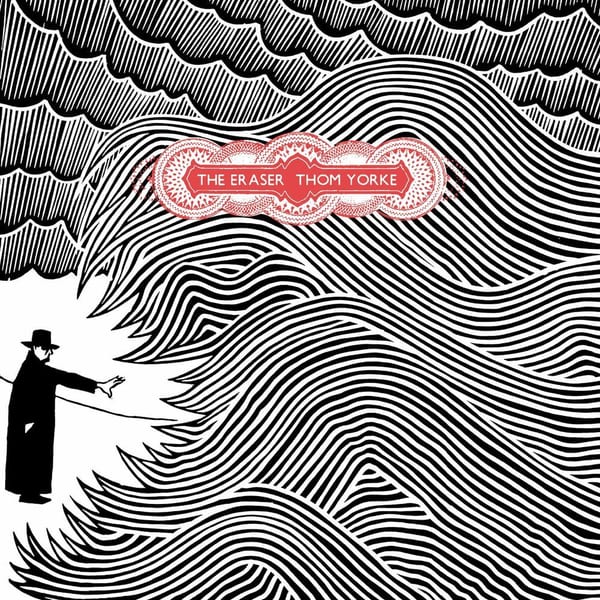
Stanley Donwood's cover, a linocut called London Views, shows a lone figure facing a wall of floodwater swallowing the city. Donwood tied it to the legend of King Canute failing to command the tide, and to climate dread. Water runs all through the album, rising, dripping, refusing to be held back. In 2006 that read as mood. It reads differently now.
Where it actually went
Commercially the thing did fine, better than Yorke's "please ignore this" framing suggested: number three in the UK, number two in the US, a Mercury Prize nomination. But its real life was downstream.
The closing track was called "Atoms for Peace," after Eisenhower's 1953 speech. Three years later Yorke borrowed the name for the band he assembled to play these songs live, a group with Flea from the Red Hot Chili Peppers on bass and Godrich on everything else. They eventually made their own album.
Amok (2013) is what happens when you hand these skeletal electronic sketches to a real rhythm section and let them breathe. And the laptop-solo instinct never left. You can draw a straight line from The Eraser to the paranoid, clenched electronics of his second proper solo record.
ANIMA (2019) is the fuller, stranger cousin, Yorke's fear translated into full-body rhythm and a Paul Thomas Anderson short film. Even last year's Tall Tales, made with Mark Pritchard, lives in the world The Eraser opened up.
Why it still matters
The easy read on The Eraser is that it's minor Radiohead, a footnote between Hail to the Thief and In Rainbows. I think that's exactly backwards. It's the record where Yorke figured out he could be a musician outside the band without the sky falling in, and everything he's done alone since, the film scores, the Atoms for Peace detours, the Mark Pritchard collaborations, runs through it. If you only know it as "the one with Radiohead's singer doing electronic stuff," go back. It's warmer and sadder and angrier than its reputation.
For where this sits in Yorke's day job, our Kid A vs OK Computer piece has the band argument that never dies. But rate The Eraser on its own terms below, and tell me: minor curio, or the most underrated thing he's made? The comments are open, and I'll defend the second position all day.
Discussion
Disagree? Have a better record in mind? Say it — top takes rise.
Sign in to join the discussion.
No one's weighed in yet. Go first.