Blog/Deep Dive
Time (The Revelator) at 25: the album where Gillian Welch became an author
Two people, one microphone, live to tape — and a set of old-time songs that saw the whole streaming decade coming.
Riffiter5 min read
Time (The Revelator), released July 31, 2001, is Gillian Welch's third album and the first record on Acony, the label she and David Rawlings founded after leaving the majors. Recorded live to tape at Nashville's RCA Studio B, it turned old-time forms into songs about American myth, mortality, and the collapse of the music business.
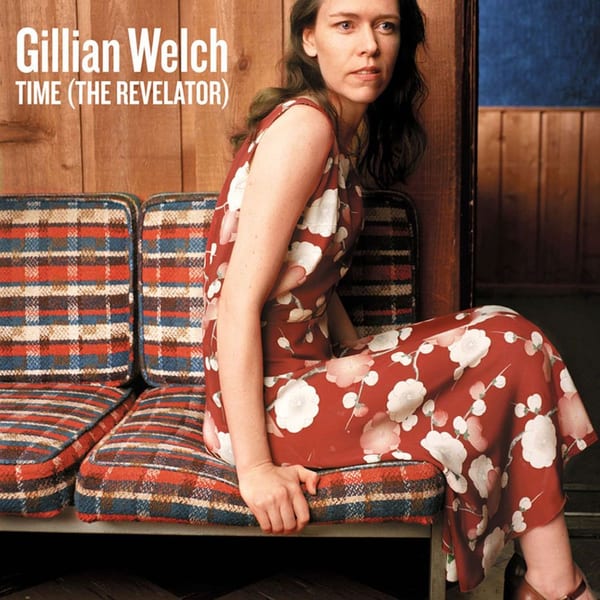
Gillian Welch spent her first two albums being told she was too good at sounding old. Then she made a record that used the old sounds to say something nobody had said before.
Leaving the machine
Welch turned up in the late nineties looking almost suspiciously authentic. A Californian raised on the Carter Family, she sang close-harmony murder ballads with David Rawlings as if the two of them had wandered in from 1932. The praise came with a raised eyebrow: was this the real thing, or a very good costume?
Revival (1996) and Hell Among the Yearlings (1998) came out on Almo Sounds, the label run by A&M's founders Herb Alpert and Jerry Moss. When that arrangement wound down around the turn of the century, Welch and Rawlings didn't go looking for another major. They started their own label, Acony — named after a wildflower Welch had already written a song about — and made Time (The Revelator) the first record it ever released. You can hear that freedom in every decision on the album.
Two people, one room
They cut it live to tape at RCA Studio B in Nashville, the room where Elvis and the Everly Brothers made hits, with almost nothing between the microphones and the songs. Two voices, two guitars, a little banjo, and long stretches of air. Rawlings produced it and mostly stayed out of its way. One song, "I Want to Sing That Rock and Roll," was recorded live at the Ryman for a documentary and dropped straight onto the record with the audience still in it.
The restraint is the sound. Where a lot of Americana reaches for warmth, Time (The Revelator) runs cool and spacious, every note left to hang. It's an album about time, so the band gave the songs room to take theirs.
The myths underneath
The words are where the record stops being a revival and starts being a body of writing. "Elvis Presley Blues" imagines the King dying, and quietly links him to Charley Patton and the whole line of people who shook themselves to death for an audience. "My First Lover" tucks a Steve Miller reference into a song about someone you can't shake.
The centerpiece is a pair of songs about a single date. "April the 14th, Part 1" and "Ruination Day, Part 2" braid together three American catastrophes that all fell on April 14: Lincoln's assassination in 1865, the Titanic hitting its iceberg in 1912, and the Black Sunday dust storm of 1935. Welch found the pattern by accident, piecing it together from a Woody Guthrie song about the dust and a Blind Willie Johnson song about the Titanic, then catching a Lincoln documentary and realizing the dates lined up. She built two songs out of the coincidence and never spelled the connection out. You either follow the thread or you don't.
The song that saw it coming
And then there's "Everything Is Free," which has quietly become the most prophetic thing on the record.
Welch wrote it as Napster was pulling the recording industry apart, though she's always said it isn't really about Napster. It's about the fear of watching the ground shift under the idea that making music might pay for a life. "Everything is free now," she sings, flat and unbothered, "that's what they say." A quarter-century later, in the streaming economy the song predicted almost to the letter, it reads less like a lament than a warning that came true. Courtney Barnett has covered it on late-night TV, Father John Misty recorded a version, and Phoebe Bridgers turned it into a live standard, hauling different guests onstage to sing it with her. A song about music becoming worthless became one of the most valuable in her catalogue.
Fourteen minutes at the end
The album closes on "I Dream a Highway," which runs fourteen and a half minutes and had never been played before the day they recorded it. Rawlings has said they played it through twice and spliced the two takes together. It should be an endurance test. Instead it works like weather, the same handful of chords rolling past while Welch's images drift and repeat, and by the end you've lost track of how long you've been inside it. That's the trick of the whole record, scaled up: make time itself the subject, then bend it.
What it started
Time (The Revelator) didn't sell like a hit and wasn't meant to. What it did was turn Welch and Rawlings from gifted revivalists into a self-contained institution, running their own label on their own terms. The cost of that independence showed up later as long silences. After Soul Journey (2003) came eight years of near-nothing before they resurfaced.
The Harrow & The Harvest (2011) was worth the wait, a darker and more fingerpicked cousin to the album that freed them. Then another long quiet.
Woodland (2024), named after the tornado-battered Nashville studio they've built their whole operation around, finally put both their names on the sleeve and won the 2025 Grammy for Best Folk Album. It's a fine late record. None of it happens without the album they released themselves in 2001, the one where they figured out that the oldest forms could carry the most modern dread.
If you come to Gillian Welch through that ache for something you can't quite name, she belongs on our yearning guide alongside the rest of the great slow-burners. Twenty-five years on, put a number on Time (The Revelator) below, and tell us which of these songs got its hooks into you first.
Discussion
Disagree? Have a better record in mind? Say it — top takes rise.
Sign in to join the discussion.
No one's weighed in yet. Go first.