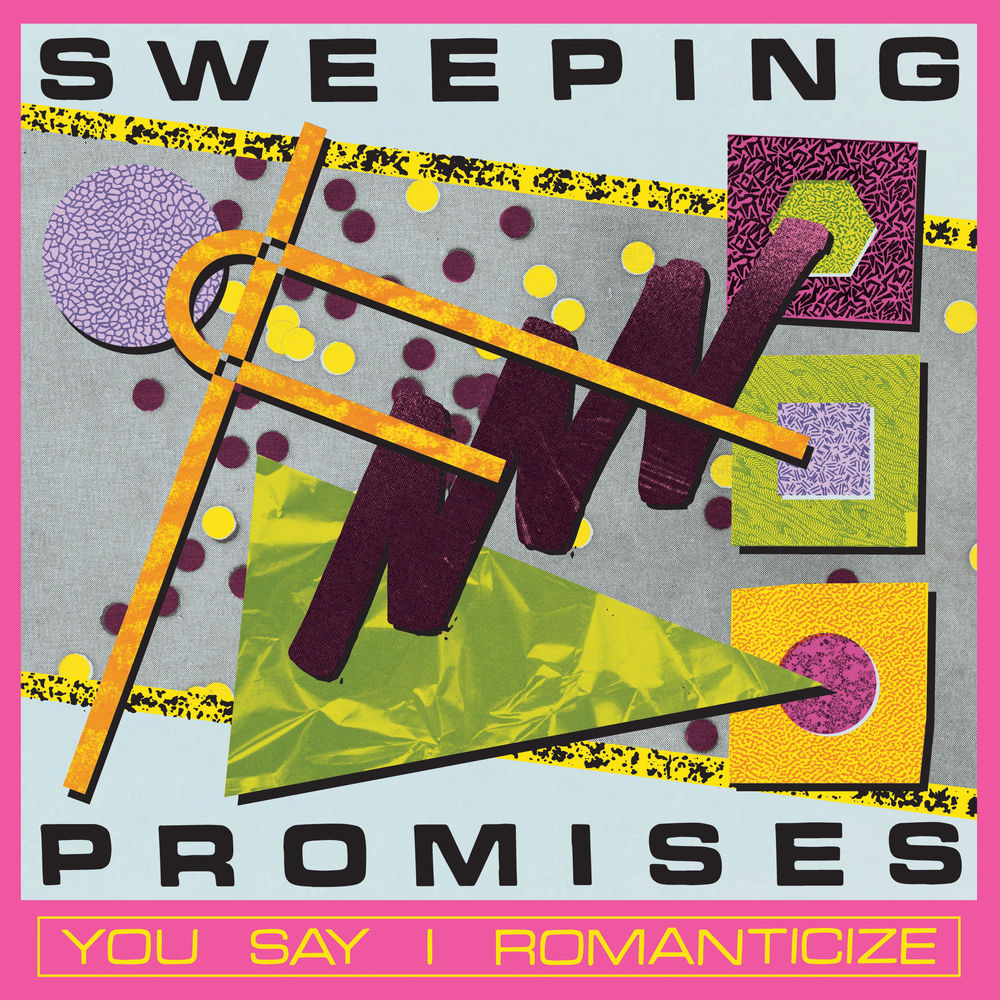
Sweeping Promises spent two albums hiding great songs behind one microphone
You Say I Romanticize drops the lo-fi costume Sweeping Promises built their name on. The songs don't just survive it. They needed it gone.
ReviewRiffiter5 min read
Sweeping Promises made their name on a single-mic recording trick that made their post-punk sound like a lost 1979 record. On their third album, You Say I Romanticize (Sub Pop, 2026), the Kansas duo finally trade fidelity for muscle. The songs prove the constraint was never the point.
Every band that gets famous for a limitation eventually has to decide whether the limitation was the point. Sweeping Promises spent six years as the answer to a trivia question: the band that recorded with one microphone. On their third album they stop answering it, and the record is better for the silence where the gimmick used to be.
The myth was the microphone
Lira Mondal and Caufield Schnug started Sweeping Promises in Boston in 2019, in an abandoned science lab someone had turned into an art space. When they made their debut, they set up a single microphone in a concrete bunker in Cambridge and played into the room, catching the guitars, the bass and Mondal's voice as one live smear. The title track was reportedly written in a matter of minutes and cut the same way.
Hunger for a Way Out (Feel It Records, 2020) landed in the first weeks of lockdown and sounded like a rescued artifact, all angular guitar and cheap synth and a rhythm section recorded in a stairwell. Critics reached for the obvious comparisons, early Rough Trade and the DIY end of new wave, and filed the band under lo-fi. The fidelity became the story. It was easier to talk about the microphone than the fact that these were sharp, fast, genuinely catchy songs.
What they actually kept
Here is the tell nobody clocked at the time: the trick kept changing and the quality didn't. The duo rode out the pandemic by moving to Lawrence, Kansas, buying a house with a studio attached, and by their second album they had already loosened the single-mic rule.
Good Living Is Coming for You (2023) was, in Schnug's words, "a slightly more complexified recording, but we still want to be cave people." It got a wider embrace, year-end lists, the kind of reviews that treat a band as a fixture rather than a novelty. And it worked for the same reason the debut did, not the recording method. Mondal writes bass lines that function as lead melodies, Schnug leaves space where a lazier guitarist would fill it, and the two of them build tension out of restraint. Strip the tape hiss and the songs are still there. That is the thing the lo-fi framing kept obscuring.
The costume comes off
You Say I Romanticize (Sub Pop, 2026) was recorded over 18 months in the Kansas studio, in between Schnug's outside production work, and it is the first Sweeping Promises album that sounds like a full band in a real room. They call their new approach an idiosyncratic chamber method, which is a fancy way of saying they finally chased a wall of sound instead of a rescued-cassette blur. Touring drummer Spenser Gralla plays across the whole thing, and his presence is the difference. The rhythm section stops being a suggestion and starts hitting.
The opener "Shooting Shadows" makes the case in under three minutes. Mondal's bass is primal and up front, Schnug snaps between single notes and power chords, and Mondal's voice does something the old records physically couldn't capture: it shouts, cracks, drops to a whisper and gets caught in full detail. On Hunger for a Way Out that performance would have been a smudge. Here you can hear every decision. Turns out the "lo-fi band" had a belter hiding in the mix the whole time.
The outcasts on the tracklist
The other thing the fidelity buried was that Mondal writes like someone with a reading list. You Say I Romanticize is a record about outcasts and shut-ins, people who turn isolation into obsession and obsession into work.
"Last Man" borrows from Mary Shelley's The Last Man, her forgotten dystopian novel about the sole survivor of a plague. "My Anchoress" is sung from the perspective of Julian of Norwich, the 15th-century mystic who had herself walled into a cell beside a church and wrote the first book in English known to be authored by a woman. The closer, "Write Lightly," is about self-expression getting compromised the moment you try to share it. It is a strange, literate cluster of subjects for a band still routinely described by its recording gear, and it rewards the kind of listener who reads liner notes and then goes looking for the source.
That art-punk lineage, brains and volume in the same three-minute burst, runs straight back through the records in our post-punk city by city guide. Sweeping Promises belong on that shelf, and You Say I Romanticize is the album that finally proves it without an asterisk about the tape.
So: is it their best?
I think it is, and I think it will cost them the exact fans who loved the myth most. Some people came to Sweeping Promises for the bunker sound, and a cleaner, louder, more confident record is going to read as a loss to them. My argument is the opposite. Two albums of great songwriting wearing a lo-fi disguise, and the disguise finally slips. What is left is a band that was always this good and can now be heard being it.
Rate all three below and settle it for yourself. Was the microphone the magic, or were you always listening to the songs? The comments are open, and this one is worth an argument.
Discussion
Disagree? Have a better record in mind? Say it — top takes rise.
Sign in to join the discussion.
No one's weighed in yet. Go first.