Blog/Deep Dive
Ridin' Dirty at 30: no single, no video, and the record Houston built itself on
Jive Records gave UGK almost nothing in 1996. Pimp C and Bun B went gold anyway, and the South spent the next decade catching up.
Riffiter5 min read
UGK released their third album, Ridin' Dirty, on 30 July 1996 through Jive Records with no official single and no music video. It reached No. 15 on the Billboard 200 and No. 2 on the R&B/Hip-Hop chart, went gold, and has since sold more than 850,000 copies, making it the Port Arthur duo's best-selling record and the album most often named as the foundation of Houston rap.
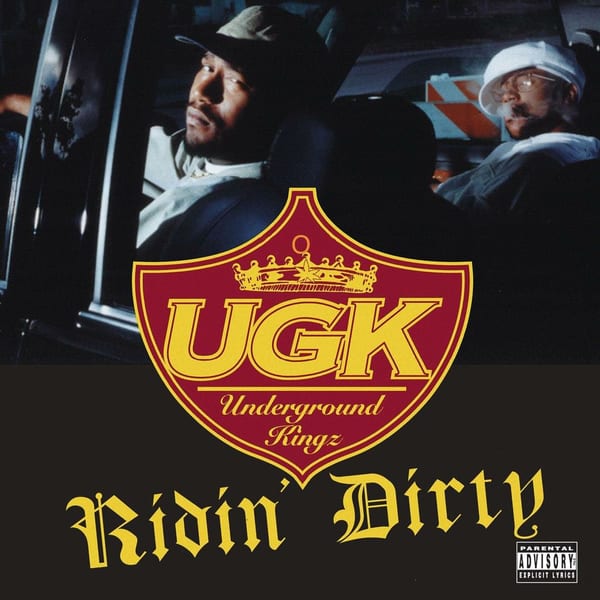
Thirty years ago last week, on 30 July 1996, Jive Records put out a UGK album and did essentially nothing with it. No single was worked to radio. No video was shot. The national music press, deep in its Fugees and Reasonable Doubt year, did not review it.
Ridin' Dirty went gold anyway, hit No. 15 on the Billboard 200, and has now moved north of 850,000 copies on word of mouth and car speakers. Every serious argument about Southern rap starts here, which is a strange fate for a record the industry treated as a rounding error.
They took equipment instead of money
The first smart thing UGK did was refuse the advance. Rather than take cash from Jive, Chad Butler and Bernard Freeman, better known as Pimp C and Bun B, negotiated for recording gear, which meant nobody could sit in the room and tell them what a hit sounded like. Bun B has said he had never seen Pro Tools before they made this album on it.
That trade explains the record's texture. It doesn't sound like a label project with a budget and a deadline. It sounds like two men from Port Arthur, Texas, working slowly in a room they controlled, with the New Orleans producer N.O. Joe as the other set of ears.
Pimp C produced it like a soul record
By 1996 the dominant sound in rap was collage: chop the loop, layer the drums, let the sampler do the arranging. Pimp C went the other way. He built from skeletal ideas and then hired people to play them, including Leo Nocentelli of the Meters and the guitarist and bassist Corey "Funkafangez" Stoot. He sang his own hooks, badly and perfectly, in a register no rapper of that era would have risked.
The reference points are Curtis Mayfield, Isaac Hayes, Bootsy Collins, the Fatback Band. This is country soul with rapping on it, which is why the album still sounds warm while a lot of 1996 sounds like a hard drive. Compare it to what UGK had done two years earlier and you can hear a producer arriving at his own language.
It's an album about dying, sold as an album about cars
Everyone remembers the candy paint and the wood grain. Fewer people notice that the first real song on the record, "One Day," is about how quickly a life ends. It grew out of an unreleased Mr. 3-2 recording built around the Isley Brothers' "Ain't I Been Good to You," and it opens the album on a funeral note rather than a victory lap.
"Diamonds & Wood" does the same trick from the other direction. The groove is luxurious. The lyrics are about what money does to a family. Pimp C's genius as a writer was that he never separated the pleasure from the bill, and the album keeps handing you both in the same bar.
That refusal to pick a mood is what makes Ridin' Dirty age better than nearly everything around it. Bun B put it plainly years later: they tried to tell the truth, and the truth remains.
The critics turned up fifteen years late
Nothing about the album's reputation in 1996 predicted its reputation now. Houston was covered, when it was covered, as a regional curiosity. Scarface had already made The Diary in 1994 and the Geto Boys had been through a national moral panic, yet the assumption that the South was a market rather than a scene held firm.
Two things chipped away at it. First, the rappers heard it: Scarface played the album for Tupac Shakur, who praised it in the weeks before he was killed in September 1996. Second, the retrospective machine caught up: Pitchfork got round to it years later and handed it a 9.5.
The same year Atlanta was making its own case. Put the two side by side and 1996 stops looking like a New York year at all.
The screw tape afterlife
Radio ignored the album, so Houston circulated it the way Houston circulated everything in the nineties: slowed down, on tape, sold out of a house. Screw culture did the promotional work Jive wouldn't, at half speed and twice the length. The proof arrived eight years later, when Jive itself put out an official chopped and screwed edition of the record. A label that couldn't be bothered to fund a video in 1996 was, by 2004, repackaging the same album for a market it had spent a decade failing to notice.
What it built
Houston's commercial decade in the 2000s runs directly out of this album's methods: local control and slow-burn regional sales, from a scene that had stopped asking permission. Memphis was doing its own version of the same maths.
The ending is brutal. Pimp C went to prison in August 2002 and came home at the end of 2005. In 2007 UGK returned with Underground Kingz, which debuted at No. 1 with "Int'l Players Anthem (I Choose You)," the OutKast collaboration that finally made them a national act. Pimp C died that December in a West Hollywood hotel room, aged 33, from a mix of codeine and promethazine compounded by sleep apnea. He got about four months of being properly famous.
Ridin' Dirty was the record he made when nobody was watching, and it is the one that lasted. If you want more of the year that produced it, our guide to the best albums of 1996 covers the wider field.
Thirty years on, the argument worth having isn't whether the album is great. It's whether it's the best Southern rap record ever made, and whether Super Tight has a stronger front half. Rate it above, then go argue in the comments.
Discussion
Disagree? Have a better record in mind? Say it — top takes rise.
Sign in to join the discussion.
No one's weighed in yet. Go first.