Blog/Deep Dive
Daniel Stewart left Melbourne to stop repeating himself. Station Model Violence is what came back.
Six people, one saxophone, an eight-minute centre. The best-argued post-punk record of 2026 came out of a man moving cities and starting over.
Riffiter5 min read
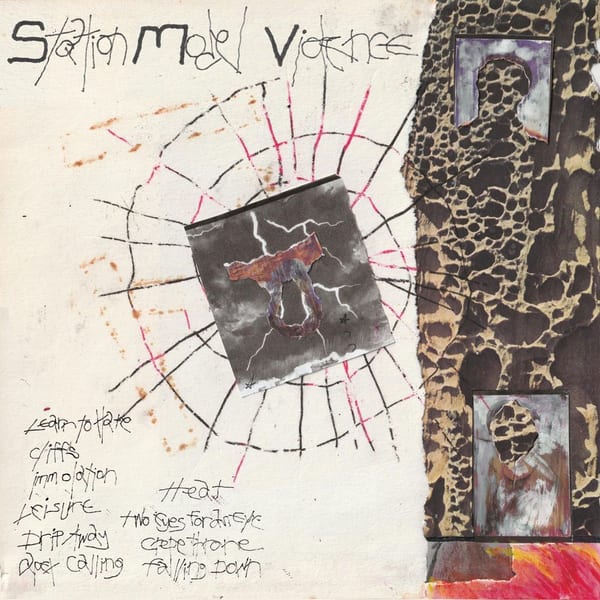
Station Model Violence is the self-titled debut by a Sydney six-piece fronted by Daniel Stewart of Total Control and The UV Race, with members of R.M.F.C., Den and Gaud. Released 27 February 2026 on Anti Fade in Australia and Static Shock in the UK and mixed by Mikey Young, it runs motorik pulse, serrated guitar and saxophone through ten songs, including the eight-minute "Heat".
Almost nobody starts a new band twenty years in. You keep the old one going, you do a reunion, you produce other people, you get a job. What you do not usually do is move cities, find five players half your scene has never met, and make the loudest record of your life.
Daniel Stewart did that. After Melbourne's long run of lockdowns he moved to Sydney at the end of 2022 with what he has described as an overwhelming need to start something and sing again. Three and a bit years later the result is out, and it is the best Australian rock record I have heard this decade.
Who is actually in this band
Stewart, who goes by DX, spent the 2010s fronting Total Control and playing in The UV Race, two of the most argued-over bands in Australian underground music. Total Control in particular were never a punk band so much as a punk band's disagreement with itself: synth drone on one track, hardcore on the next, nobody in the group interested in resolving it.
Station Model Violence is his Sydney reset. Buz Clatworthy and Alan Gojak come from R.M.F.C., Clatworthy's own project and one of the sharpest garage-punk operations in the country. Micky Grossman and Michael Hassett come from Den. Nick Kuceli, from Gaud, plays the saxophone.
The songs arrived from three different directions: demos Clatworthy had never used, material salvaged from an unrealised group called KX Aminal, and things the six of them wrote once they were in a room. That is normally a recipe for a compilation rather than an album. It is not what happened here.
What it sounds like
Stewart has pointed at a very specific origin: a moment in a BBC krautrock documentary where Iggy Pop describes Neu! as pastoral psychedelicism. That phrase turns out to be a decent map of the record.
The pulse underneath most of these songs is motorik, a steady forward push borrowed from the German bands we mapped in our krautrock guide, but the surface is all corrosion. Guitars come in thin and serrated rather than thick. The saxophone is not garnish or a nod to no wave, it works as pressure, thickening the air in the top half of the mix until the songs feel physically crowded.
"Learn to Hate" opens with the band already at speed. "Drip Away" is done in one minute fifty-two and spends it on machine dread. "Cliffs" is the outlier, and by Stewart's account it points at John Cale's Paris 1919, which is not a reference anyone else in Australian punk is making right now.
Then there is "Heat", eight minutes and eighteen seconds sitting in the middle of the album like a wall. It locks a groove and refuses to develop it in any of the ways you expect, adding layers instead of changes. Bands with this much collective experience usually shorten things. Putting the longest song at the centre of a debut is a dare.
The Mikey Young effect
The record was tracked at the start of 2025 and then mixed across the rest of the year by Mikey Young, who called it a dense beast and needed months on it.
Young has been the connective tissue of Australian underground music for fifteen years, first as the guitarist in Eddy Current Suppression Ring and since then as the mixing and mastering engineer behind an absurd share of the country's good records. His signature is restraint: he lets things stay ugly. Nothing on Station Model Violence has been smoothed into a shape that would work on radio, and the sax on the loudest passages is allowed to be genuinely unpleasant.
That matters because the alternative was obvious and easy. A six-piece post-punk band with saxophone in 2026 could have been produced into a very tidy product. Half of the current wave has been.
The argument against it
There is one, and it should be said out loud. Treble's review liked the record but thought it lost some distinctiveness in the haze of its influences, which is the standard charge against every band working in this idiom right now. Post-Trash went the other way and called it one of the best punk records of the year and possibly the decade.
I lean hard towards Post-Trash, with a caveat. The influences really are close to the surface: you can hear Wipers in the guitar tone, you can hear the Birthday Party's sense of theatre, and you can hear a lot of 1979 to 1981 in the rhythm section. What separates it is intent. This is not a young band assembling a sound from records they love. It is six people who have already made those records themselves, playing at the edge of what they can control.
Where it lands
In May the band shared a bill with Dry Cleaning at the Sydney Opera House for Vivid LIVE, which is a strange sentence to write about anyone on Static Shock's roster.
Dry Cleaning's Secret Love, which we wrote about earlier this year, is the other post-punk record of 2026 that people will still be arguing about in a decade. The two of them together on one stage says something about where this music is now: not a revival any more, not underground exactly, just the working language of a lot of very good bands who have stopped apologising for their record collections.
Station Model Violence has no interest in explaining itself. It arrived in February with coverage confined mostly to the specialist blogs, and it will end up on a lot of year-end lists made by people who found it on their own.
Rate it above. If you think it is a rerun of things that already happened in Melbourne fifteen years ago, say so in the comments and make the case. I would like to see somebody try.
Discussion
Disagree? Have a better record in mind? Say it — top takes rise.
Sign in to join the discussion.
No one's weighed in yet. Go first.