Blog/Deep Dive
Odelay at 30: the album that turned junk culture into pop
Thirty years ago today Beck handed the Dust Brothers a pile of records and got back the strangest No. 1-adjacent album of the decade.
Riffiter5 min read
Beck's Odelay was released on June 18, 1996, produced largely by the Dust Brothers and built from a magpie hoard of samples — folk, funk, hip-hop, country and noise. It won the Grammy for Best Alternative Music Album, made “two turntables and a microphone” a generation's catchphrase, and remains the high-water mark of 1990s sample-collage pop. Thirty years on, here's why it still sounds like the future arriving sideways.
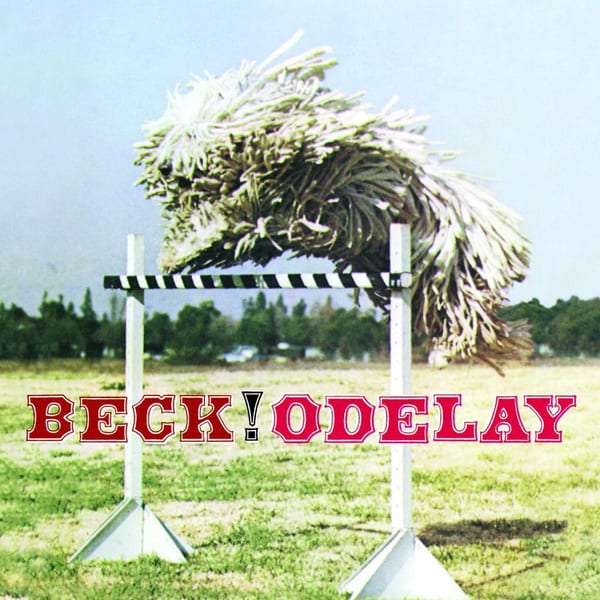
Thirty years ago today — June 18, 1996 — a 25-year-old who'd been written off as a one-hit slacker put out a record made of garbage. Not figuratively. Odelay is built from offcuts: a stray sitar loop here, a thrift-store funk break there, a country guitar line, a blast of distortion, a sample of a sample. Beck and his producers treated American music history like a skip outside a recently evicted house and walked away with the most joyful album of the decade.
The miracle is that it doesn't sound like a junk pile. It sounds like a parade.
How a folk album became a sample collage
Rewind two years. Mellow Gold (1994) had given Beck "Loser," a sardonic acoustic-meets-hip-hop fluke that lodged itself in MTV rotation and saddled him with the slacker tag he'd spend years outrunning.
His instinct for the follow-up was to retreat — he started cutting a quieter, more acoustic, singer-songwriter record, the kind of move that would have confirmed every lazy assumption about him. Then he scrapped most of it. The pivot came when he hooked up with the Dust Brothers, the Los Angeles production duo of Mike Simpson and John King, whose résumé already included the most ambitious sample record ever made.
The Beastie Boys' Paul's Boutique (1989) was the Dust Brothers' calling card: a wall of samples so dense it could never be legally cleared today, a commercial flop that turned into a cult monument. Beck wanted that maximalism, but pointed somewhere weirder — not just funk and hip-hop but Delta blues, Bakersfield country, garage rock, mariachi. He'd show up with crates of records; the Dust Brothers would chop and stack; Beck would write over the top in his half-nonsense, half-poetry deadpan. The album took shape not as songs played by a band but as collages assembled in a room.
"Two turntables and a microphone"
The lead single is still the thesis statement. "Where It's At" — released that May — is held together by a vocal hook lifted from old-school rap group Mantronix's "Needle to the Groove": we've got two turntables and a microphone. It's a deliberate nod to hip-hop's foundational tools, dropped into a song that's otherwise built from a sex-ed record, a cheesy organ and Beck's own non-sequiturs. The line became a generation's catchphrase precisely because nobody could explain what the song was about. It didn't need to be about anything. It was about where it's at, which turned out to be everywhere at once.
That's the trick of the whole album. "Devils Haircut" rides a fuzzed-out riff sampled off an obscure soul record into something that sounds like garage rock from Mars. "The New Pollution" floats a saxophone loop over a bossa-nova lilt and a chorus too pretty for how cynical the words are. "Jack-Ass" slows a Them/Van Morrison-derived loop into a hungover daydream. Each song is genre tourism conducted at speed, and somehow none of it reads as pastiche — because Beck's voice, flat and amused and faintly heartbroken, is the constant that makes the chaos cohere.
The album that made eclecticism respectable
Odelay arrived to near-unanimous acclaim, and then it did the thing slacker flukes aren't supposed to do: it won. At the 1997 Grammys it took Best Alternative Music Album, and "Where It's At" won Best Male Rock Vocal Performance, with the album itself nominated for Album of the Year. The kid from the "Loser" video was suddenly a critical institution.
What it really did was license a way of making records. The mid-90s were thick with sample-built music finding its high-art register — the same instinct that produced the great sample-collage records of the era was in the air, and Beck plugged American roots music into it. Compare it to the other 1996 monument of crate-digging, released a few months later:
DJ Shadow's Endtroducing..... used the sampler to build cinematic melancholy entirely from other people's records. Beck used the same tools to build a carnival. Between them, 1996 made the case that a sampler in the right hands was an instrument, not a shortcut — that you could author something genuinely new out of fragments of everything old.
Why it still holds up
Plenty of 90s records that sounded cutting-edge now sound like their decade wearing it on a lanyard. Odelay doesn't, and the reason is its refusal to commit to any single sound long enough to date. It's not a hip-hop album or a rock album or a folk album; it's a record about the joy of refusing to choose, made by people who'd absorbed all of it and felt no obligation to be reverent about any of it. The streaming era — where a playlist swings from drill to bossa nova to shoegaze without blinking — caught up to Odelay's logic about fifteen years after the fact.
Thirty years on, the junk-culture maximalism still sounds like generosity: more ideas in three minutes than most bands manage in a career, all of it offered with a shrug. Put it on loud. Then go argue about whether Sea Change is the better record, or whether nothing Beck made after this came close.
**Where does Odelay rank in Beck's catalogue for you — peak, or the start of the decline? Rate it above and make the case in the comments.**
Discussion
Disagree? Have a better record in mind? Say it — top takes rise.
Sign in to join the discussion.
No one's weighed in yet. Go first.