Blog/Field Guide
Krautrock was a British joke. Underneath it were three different countries of sound
The word the Germans hated, the music they actually made, and why 'best krautrock albums' is really three separate lists.
Riffiter6 min read
"Krautrock" is an outsider's word — coined by the British music press for the wave of experimental German rock made roughly 1968–1976. The bands mostly loathed it and preferred "kosmische Musik." Underneath the single label sat at least three unrelated scenes: the motorik pulse of Düsseldorf, the tape-edited groove of Cologne's Can, and the Berlin cosmos of synth explorers. This field guide maps the deep end.
Start with the name, because the name is a lie.
"Krautrock" was never a genre the bands chose. It was British shorthand — half affectionate, half sneering — for a wave of German records that turned up in the UK in the early '70s sounding like nothing the Anglo-American rock machine was making. The Germans, when they used a word at all, said kosmische Musik: cosmic music. Faust found the joke funny enough to open their fourth album with a twelve-minute track called "Krautrock" and let the label wear itself out.
What almost none of it shared was a sound. Search "best krautrock albums" and you'll get a list that treats Kraftwerk, Can and Tangerine Dream as one movement. They weren't. They were three different reactions to the same problem, made in three different cities that barely spoke to each other.
The problem they were all solving
Here's the thread that actually connects them, and it isn't musical. It's a refusal.
The generation that made these records grew up in the rubble of a country whose recent culture had been poisoned. Imitating American blues-rock or British beat music felt, to a lot of them, like borrowing an identity because their own was radioactive. So they started from zero — new rhythms, new machines, new ways of building a track that didn't route through Chuck Berry or the Delta. Year Zero was the point. Everything below is a different answer to "what do you build when you refuse the blueprint."
Düsseldorf: the straight line
The most influential answer was also the simplest: a steady 4/4 pulse that never resolves and never lets up. Klaus Dinger, who played it, called it the Apache beat; the world calls it motorik. Once you've heard it you hear it everywhere after.
Neu! invented it in 1972 — Dinger and Michael Rother, both fresh out of an early Kraftwerk lineup, with Conny Plank engineering. "Hallogallo" is ten minutes of forward motion and almost nothing else, and that "almost nothing else" is the entire idea. Bowie built half of "Heroes"-era Berlin on it. So did every band that ever wanted to sound like driving.
The same city gave us Kraftwerk, who took the refusal furthest of all — by 1974's Autobahn they'd dropped the guitars entirely and become a machine. And it gave us Harmonia, a supergroup nobody bought at the time.
Harmonia was Rother plus the two members of Cluster, holed up in a converted farmhouse in Forst. Brian Eno called them the most important rock band in the world in 1974, which was both wildly premature and, in hindsight, roughly correct — their weightless electronic pastoral is the missing link between krautrock and every ambient record that followed.
Cologne: the edit
Can were art-school avant-gardists slumming it in rock, and they made the most physical music of the lot.
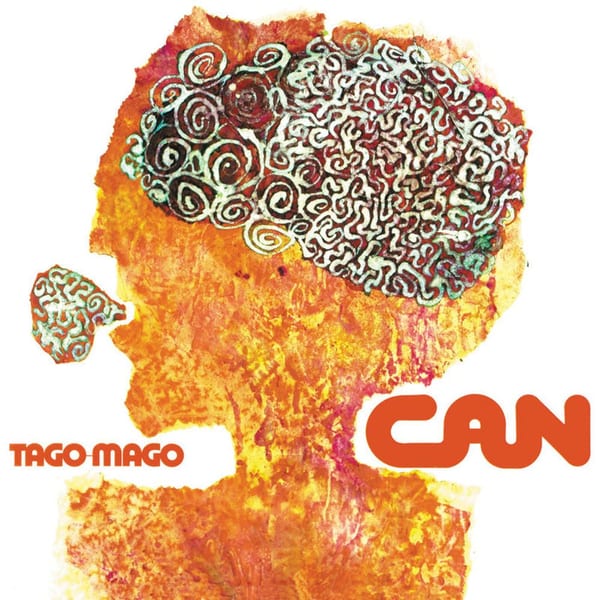
Holger Czukay studied under Stockhausen; Irmin Schmidt conducted orchestras. Then they heard the Velvet Underground and James Brown and decided the future was groove you could cut apart. Tago Mago (1971) is the peak — a double album built on Jaki Liebezeit's superhuman drumming and Damo Suzuki's improvised, half-intelligible shouting, then spliced into shape on tape. "Halleluwah" is eighteen minutes and feels like six. This is krautrock as editing, not composition — the finished track assembled from the wreckage of a jam.
You can draw a straight line from here to post-punk. The Fall, PiL, Talking Heads, half of the records made after 1978 — they all took the Can lesson that repetition plus a great rhythm section plus scissors beats a chorus.
Berlin: the cosmos
The third city went inward and upward. Where Düsseldorf drove and Cologne grooved, Berlin drifted — the actual kosmische wing, built on early synthesizers and a taste for the infinite.
Tangerine Dream, Ash Ra Tempel, Klaus Schulze: long-form, beatless or barely-beated, more interested in a single evolving cloud of tone than any song. It's the branch that seeded ambient and, once the sequencers got cheap, techno — Detroit's founders were listening hard. Cluster started here too, before the move to Forst, and their 1974 record is where the cosmos learned to be playful.
Zuckerzeit is Moebius and Roedelius discovering the drum machine and treating it as a toy — wonky, warm, pop-shaped miniatures that predict about forty years of home-studio electronica. If the Berlin school sometimes disappears up its own event horizon, this is the record that keeps its feet on the ground.
The tributaries
The three-city map is clean, which means it leaves things out. Munich gave us Amon Düül II, born from a political commune, sprawling and heavy and genuinely psychedelic in a way the northern bands weren't.
Yeti (1970) is their monster — side-long improvisations that lurch from folk to acid-rock freakout, closer to the American underground than anything in Düsseldorf. And in Munich too was Popol Vuh, Florian Fricke's project, which started on a Moog the size of a wardrobe and then abandoned it for choirs and acoustic mysticism.
Hosianna Mantra (1972) trades the machine for piano, oboe and a soprano, and it's one of the most quietly devastating records of the whole era — Fricke went on to score most of Werner Herzog's best films, which tells you something about the pictures this music paints. And then there's Faust, the pure anti-everything, whose collage records at the Wümme studio treated the album as something to be broken rather than made.
Faust IV (1973) is the closest they came to accessible, which is to say it's still wilfully strange — the "Krautrock" track that opens it is eleven minutes of drone as a shrug at the whole enterprise.
Where it went
Nothing this fertile stays buried. Post-punk took Can. Ambient took Berlin and Harmonia. Techno took the sequencers. Post-rock took the motorik pulse and stretched it. The word was a joke, but the joke pointed at the most quietly influential body of work in European rock — a scene that mattered precisely because it refused to sound like the scenes it came from. For a parallel case of a non-Anglophone country building its own psych language from scratch, our Anadolu psych guide maps Turkey's version of the same instinct; the Japanese ambient canon picks up where the Berlin school left off.
So: which krautrock is your krautrock — the pulse, the edit, or the cosmos? Rate the records above and make the case in the comments. The wrong answer is treating them like one list.
Discussion
Disagree? Have a better record in mind? Say it — top takes rise.
Sign in to join the discussion.
No one's weighed in yet. Go first.