Blog/Field Guide
City pop: past 'Plastic Love,' into the deep end
A recommendation algorithm exhumed a bubble-era Japanese genre and then stopped at a single song. The good stuff starts right after it.
Riffiter5 min read
City pop is the urban, AOR-leaning Japanese pop of the late 1970s and 1980s — Tatsuro Yamashita, Mariya Takeuchi, Taeko Onuki, Anri and others soundtracking bubble-era affluence. A YouTube-driven revival turned 'Plastic Love' into a global phenomenon; this is a field guide to the records waiting just past the meme.
Almost everyone arrives at city pop through the same door, and it's the wrong one to stop at.
Sometime in 2017, an anonymous account uploaded a 1984 Mariya Takeuchi song called "Plastic Love" to YouTube, paired with a cropped photo of the singer looking away from the camera. The site's recommendation engine did the rest. Tens of millions of plays later, a modest Japanese single that had barely charted in its own country was the unlikely soundtrack of a global mood, sampled into vaporwave and future funk, argued over on RateYourMusic, scrobbled to death on Last.fm by people who couldn't read the title. It's a great song. It's also a trapdoor. Fall through it and there's a whole decade down there.
What city pop actually was
City pop was never a scene with a manifesto. It's a loose label, mostly applied after the fact, for the sleek urban pop that came out of Tokyo studios from the late 1970s into the 1980s — Japanese musicians who had absorbed American AOR, soft rock, funk, disco and jazz fusion, then rebuilt it with a craft and a budget that most of their models couldn't match. The lyrics are about cars, coastlines, city lights, resort weekends and love affairs conducted in convertibles. It's the sound of a country getting rich and knowing it, the bubble economy set to a boogie bassline.
The through-line runs back to one short-lived band. Sugar Babe made a single album, Songs (1975), and then dissolved, but it held the two people who would define everything after: a young guitarist named Tatsuro Yamashita and a singer named Taeko Onuki. Nearly every road in city pop leads back to one of them.
The sound at its peak
Yamashita is the genre's center of gravity. He broke through with Ride on Time (1980), but the record where the whole style snaps into focus is the next high-water mark.
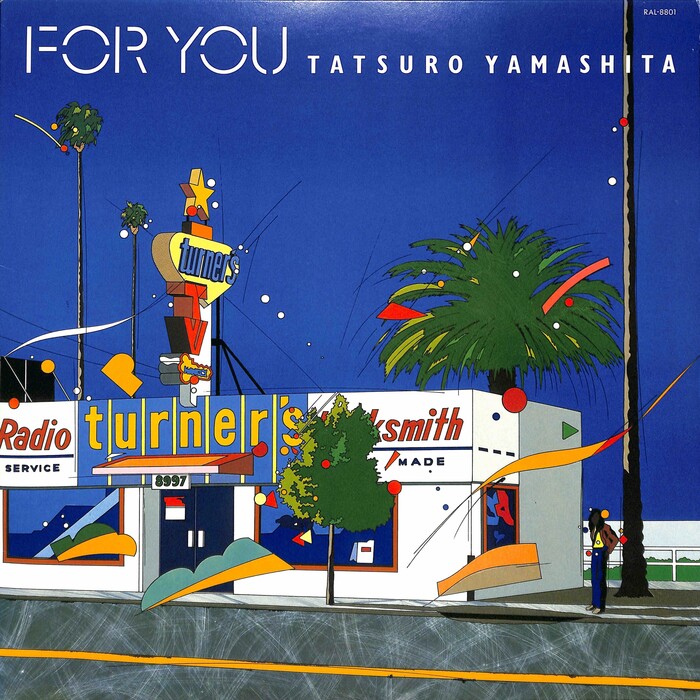
For You (1982) is city pop as a closed system — every handclap placed, every horn stab timed, the session players so tight the album barely sounds recorded so much as engineered into existence. "Sparkle" opens it on a guitar figure that has since been lifted by half of future funk, and Eizin Suzuki's sun-drenched cover illustration became the genre's visual shorthand. If you want to know why people describe this music as sounding like an endless summer that never actually happened, start here.
He also, in 1982, married a singer whose comeback album he would produce two years later.
Variety (1984) was Mariya Takeuchi's return after a few quiet years, written by her and arranged top to bottom by Yamashita, and it's a sharper record than its one famous export suggests. "Plastic Love" is on it, yes, but so is a run of songs about romantic self-protection that are wittier and colder than the dreamy meme version implies. The joke of "Plastic Love" is that it's a song about faking joy to avoid getting hurt, which is a strange thing for the internet to have adopted as pure nostalgia bliss.
Past the meme
Here's where most casual listeners stop, and where the genre gets genuinely interesting. Taeko Onuki went a different direction than her old bandmate, and for a lot of heads her records are the real prize.
Sunshower (1977) is jazzier, sadder and more sophisticated than anything on the sunny end of the spectrum, arranged largely by a 25-year-old Ryuichi Sakamoto in the years before Yellow Magic Orchestra. It moves through bossa nova, samba and string-drenched sophisti-pop, and its centerpiece, "4:00 A.M.," is the sound of an empty apartment at the exact hour the title names. If For You is the daylight, this is the comedown.
Then there's the boogie wing, presided over by a guitarist-producer who worked the funk harder than anyone.
Toshiki Kadomatsu's After 5 Clash (1984) is slap bass, brass and city-at-night propulsion — dance music for people leaving the office. Kadomatsu also produced and shaped the mid-'80s sound of Anri, whose own peak sits right beside his.
Timely!! (1983) gives you "Windy Summer" and the anime-theme monster "Cat's Eye," and it's the record where Anri stops being a light-pop singer and becomes a city pop force. It's brighter and poppier than the Onuki side of the family, and unapologetic about it.
And no map of this territory is complete without the song that beat "Plastic Love" to the punch on the algorithms.
Miki Matsubara's Pocket Park (1980) opens with "Mayonaka no Door (Stay With Me)," which went globally viral on TikTok forty years after its release and briefly topped Spotify's international viral chart. Matsubara had died in 2004, at 44, long before any of it happened. The revival she never got to see is the whole city pop story in miniature: a record made for one moment, resurfacing in another that has nothing to do with it.
Why it caught, and where to go next
The tidy explanation for the revival is nostalgia, but it's borrowed nostalgia — most of the people playing these records were not alive in 1984, and few of them have ever been to Japan. What actually travels is the craft. This is pop made by musicians who treated the studio as an instrument and refused to leave a single bar underdressed, and that kind of precision doesn't date the way fashion does.
If you want the other half of what those same Tokyo studios were building in the same years, our Kankyō ongaku canon covers the ambient side — the quiet, functional beauty being made a few doors down from all this neon. City pop is its extrovert cousin.
Start with For You, then decide which fork you're on: the daylight or the 4 a.m. Rate the six above and tell us which one actually earns the hype. And if you think "Plastic Love" is overrated now that the algorithm ran it into the ground, the comments are exactly the place to say so.
Discussion
Disagree? Have a better record in mind? Say it — top takes rise.
Sign in to join the discussion.
No one's weighed in yet. Go first.