Blog/Deep Dive
Endtroducing at 30: the album that made the crate-digger an author
DJ Shadow built a whole record out of other people's records. Thirty years and a symphony-orchestra tour later, it still sounds like nobody else.
Riffiter5 min read
Endtroducing..... (1996), the debut by Josh Davis as DJ Shadow, was recognised by Guinness World Records as the first album made entirely from samples. Released on Mo' Wax when Davis was 24, it turned instrumental hip-hop and crate-digging into composition. On its 30th anniversary Davis is touring it, including a date with the BBC Symphony Orchestra.
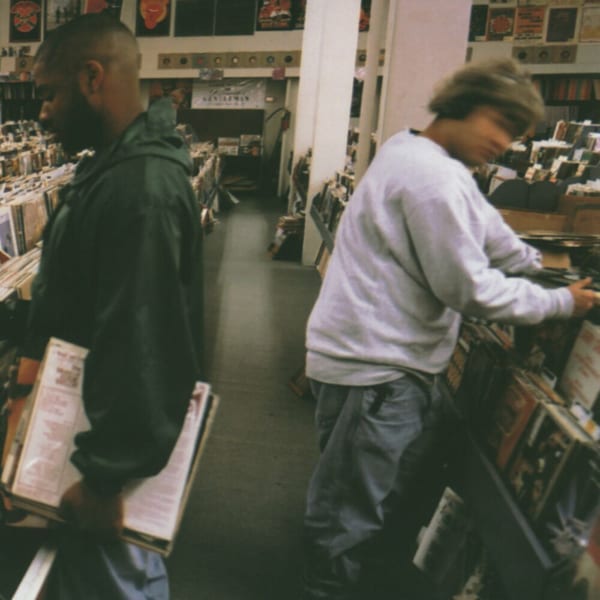
Josh Davis was 24 when he handed in a record made of dead men's records. Endtroducing..... came out on Mo' Wax on September 16, 1996, and the Guinness Book of World Records eventually gave it a title that sounds like a dare: first album made completely from samples. Over 60 vinyl sources, a single Akai MPC60, a Technics turntable, an ADAT tape deck, and roughly two years in a San Francisco basement called the Glue Factory. No band. No session players. Not one note that Davis played himself.
Thirty years on, he is taking it back out on the road, including a night with the BBC Symphony Orchestra at the Barbican. There is something funny about an orchestra performing a record assembled from scraps of vinyl nobody was supposed to hear again. There is also something exactly right about it, which is most of what this piece is about.
The lie about sample albums
The standard line on Endtroducing is that it's a feat of curation. He found great records, the story goes, and he had the taste to stitch them together. That undersells it badly, because the sources are not great records. They are mostly forgotten ones: library music, a self-help spoken-word LP, a prog drum break, jazz nobody charted, the kind of vinyl that ends up in a dollar bin in Sacramento. Davis spent hours a day at a shop called Rare Records, and that routine is the thing the documentary Scratch (2001) captures him doing, hands black with basement dust.
The achievement isn't finding good music and presenting it. It's hearing two seconds of something unremarkable and knowing what it could become. "Building Steam with a Grain of Salt" is built out of fragments that, on their own records, mean nothing. Davis heard the song they could be in and the rest of us couldn't. That's not curation. That's composition, just with a different raw material.
Why it sounds sad
People reach for the word "melancholy" with this album so often it's become a cliché, but the cliché is pointing at something real. Endtroducing sounds like grief, and I think the medium is the reason.
Every sound on it is a recording of a moment that already happened, to people who are mostly gone, pressed onto a format that was already obsolete when Davis bought it. The whole record is haunted by its own method. When the voice on "Midnight in a Perfect World" floats up out of the murk, it's a singer Davis never met, lifted out of a context he erased, made to sing one phrase forever. The album is a séance held with a sampler.
That's the part the imitators missed. Plenty of producers learned the technique. Almost none of them got the mood, because the mood wasn't a technique. It came from Davis actually feeling something about old records, about time, about being a kid in Davis, California with a stack of vinyl and no one to talk to about it.
The lineage it spawned, and outran
You can draw a clean line from Endtroducing to a whole school of instrumental hip-hop. The closest descendant might be RJD2, whose debut took Shadow's cinematic crate-digging and pushed it toward soul and pop hooks.
Deadringer (2002) is a wonderful record and it is unmistakably a child of this one. So is half the Ninja Tune catalogue, and a good chunk of what people filed under trip-hop without much thought, the scene this album is forever lumped into and never quite belonged to. (If you want the actual map of that world, we wrote one in the Bristol sound and trip-hop's golden age; Shadow sits just outside its borders, which tells you something.)
Davis himself was never interested in repeating it. He used his Mo' Wax leverage to assemble Psyence Fiction under the UNKLE name with James Lavelle, a star-studded, divisive record that confused everyone expecting Endtroducing II.
And when he did make a proper follow-up, he deliberately swerved.
The Private Press (2002) is warmer, brighter, more song-shaped, and it spends real energy not being the album that made him. I respect that more than I used to. The trap of a debut this complete is that it can become the only thing you're allowed to do, and Davis refused the trap, even when refusing it cost him.
So is it still the one?
Mostly, yes. Endtroducing has a flaw the worshippers won't admit: it sags a little in its back third, a couple of interludes that are texture more than song. It is not a flawless 40 minutes. But the best of it has not aged a day, and the thing it proved is now so deep in the water that we forget it had to be proved at all. The idea that a person alone with a sampler and a record collection is an author, not a thief or a technician, runs through every bedroom producer, every lo-fi playlist, every kid making beats on a laptop tonight. That argument was won here.
Thirty years is long enough to know which records were trends and which were doors. This was a door.
Rate it below, and tell me where you stand on the sample-album question: is building music from other people's records a craft equal to playing your own, or a clever second-best? I've made my case. The comments are where you make yours.
Discussion
Disagree? Have a better record in mind? Say it — top takes rise.
Sign in to join the discussion.
No one's weighed in yet. Go first.