Blog/Field Guide
One song, one album: records that refuse to be split into tracks
No skip button, no "best of," no shuffle. A guided tour of the albums built as a single unbroken piece — and what you gain by listening that way.
Riffiter4 min read
Some albums are a single continuous composition rather than a collection of songs — one track, start to finish, that demands you take the whole thing or nothing. From Jethro Tull's Thick as a Brick (1972) to Meshuggah's 47-minute Catch Thirtythree (2005), here is a field guide to the records that refuse to be split, why artists make them, and where to start.
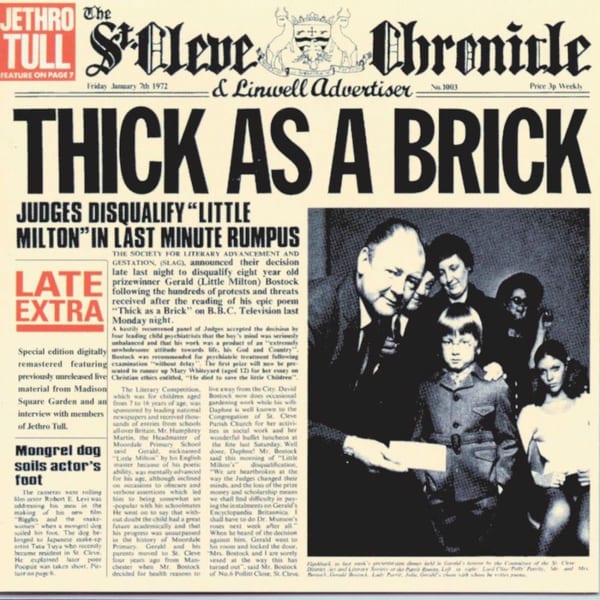
Shuffle ruined a lot of things, but it can't touch these records, because there's nothing to shuffle. Some albums are not a collection of songs at all — they are one composition, one unbroken track, designed to be taken whole or not at all. No single to pull, no track to skip, no "essential cuts" playlist. You commit to the entire arc or you don't bother.
It's the format the streaming age is least equipped to handle and the one RYM users quietly treasure. Here's a tour through the canon — the records built as a single piece, why anyone would do that to themselves, and which ones reward the commitment.
The prog blueprint
The single-piece album was a prog-rock provocation before it was anything else, and the genre's defining example is also its funniest.
Jethro Tull's Thick as a Brick (1972) is a 44-minute composition that Ian Anderson wrote as an elaborate joke — a mock-epic concept album supposedly based on a poem by a fictional eight-year-old, built specifically to parody the bloated concept records of the era. The joke is that it's genuinely brilliant. The original vinyl split it across two sides because physics demanded it, but it's one continuous piece, and it sits among the great concept albums that actually work precisely because the gag never undercuts the music.
Pink Floyd got there two years earlier, sort of. The Atom Heart Mother suite (1970) takes up the entire first side of its album — a 23-minute orchestral-rock piece co-written with composer Ron Geesin, complete with choir and brass. It remains the longest uncut piece in Floyd's catalogue, and a reminder that "one track per side" was the original constraint these records were pushing against.
The post-rock long-form
By the 1990s the single-piece album had migrated to the underground, where the point was no longer ambition but immersion — the slow build, the patient unfolding, the refusal to resolve.
Godspeed You! Black Emperor's debut F♯ A♯ ∞ (1997) is the canonical text. The vinyl edition is two side-long movements; the CD stretches to three. Field recordings, doom-laden crescendos, a tape loop that ran into a literal locked groove on the original LP so the record never quite ended. It's apocalypse as a single sustained gesture, and you can't excerpt it any more than you can excerpt a sunset.
The metal monolith
Heavy music took the format to its most punishing extreme. If prog made the single-piece album grand, metal made it heavy — in both senses.
Sleep's Dopesmoker (2003) is one riff, one song, sixty-three minutes long, about a pilgrimage of "weed-priests" across a desert. The band spent its entire major-label budget making it, and the label refused to release it as-is — which is now considered one of the great acts of artistic stubbornness in metal. It is the most committed single-song album ever made, and it asks for the same commitment back.
Meshuggah's Catch Thirtythree (2005) takes a different route to the same place: a single 47-minute track in 13 movements, much of it built on programmed drums and the band's signature polymetric grind. It's claustrophobic by design — a 47-minute machine that never lets you out — and it's the Swedish band at their most conceptually ruthless.
The whole-album-as-one-piece outliers
Not every single-piece record is literally one track on the disc. Some are albums conceived so tightly that splitting them is beside the point.
Boris's Flood (2000) is four movements that flow as one 70-minute tide — opening with ten minutes of near-silent ambient drift before the drone-metal swell arrives. The Japanese trio's masterpiece works as a single rising-and-falling breath, the kind of record you put on and don't touch again until it's over.
And then there's the format pushed to the point of absurdity. The Flaming Lips' Zaireeka (1997) is four separate CDs meant to be played on four stereos simultaneously — the "album" only exists when all four are running at once and slightly out of sync, a different mix every time. It's barely listenable as intended and completely unstreamable, which is exactly why it's beloved: a record that insists, more aggressively than any other, that you experience it on its own terms.
Why make one?
The single-piece album is a dare in both directions. For the artist it's a refusal of the marketplace — no single to service radio, no track to license, nothing to chop up for a playlist. For the listener it's a refusal of convenience — you give it forty-five uninterrupted minutes or you give it nothing.
That's the appeal. In an era engineered for the skip, these records are the last places where an album means the whole album. Once you've heard music made this way, the playlist starts to feel like eating a meal one ingredient at a time.
Rate them below — and tell us in the comments which single-piece record you'd add. The Disintegration Loops? Tubular Bells? Edge of Sanity's Crimson? Make the case.
Discussion
Disagree? Have a better record in mind? Say it — top takes rise.
Sign in to join the discussion.
No one's weighed in yet. Go first.