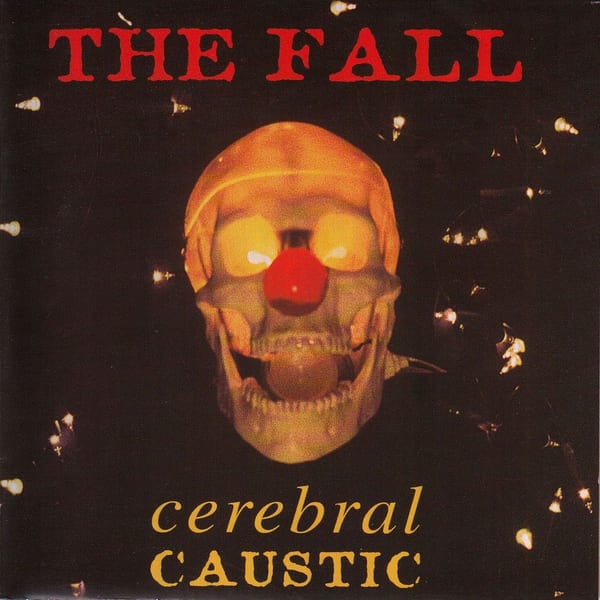
Cerebral Caustic is the Fall album nobody defends. It just got five discs.
The 1995 record where Brix came back, Craig Scanlon went, and the Fall stopped being comfortable.
Deep DiveRiffiter5 min read
Cerebral Caustic, released on Permanent Records in February 1995, is the Fall's seventeenth studio album and the one where Brix Smith rejoined the band. It spent a single week on the UK chart at number 67 and usually finishes near the bottom of fan polls. Cherry Red reissues it as a five-CD set on 28 August 2026, with rough mixes, radio sessions, an unreleased live show from Rennes and the 1995 live album The Twenty-Seven Points.
Every Fall fan has had the same conversation. Someone asks where to start, you say Hex Enduction Hour or This Nation's Saving Grace, they go away happy, and thirty-odd studio albums sit there unmentioned. The middle of that catalogue is where the real arguments are. Cerebral Caustic is the argument nobody wants to have.
It arrived in February 1995 on Permanent Records, the seventeenth Fall studio album, cut in London the year before. It spent one week on the UK chart at number 67, nineteen places below Middle Class Revolt, and that was the end of the group's last comfortable stretch. In most fan polls it lands near the bottom. On 28 August, Cherry Red is putting it back out as five CDs.
Five discs for a record people skip. I think the box is right and the polls are wrong, and the reason is exactly the thing held against it.
The year the Fall stopped being fashionable
For about five years around the turn of the nineties, the Fall were nearly respectable. There was a major-label deal, a run of records that critics liked without having to work at it, and Mark E. Smith settling into his role as the country's most reliable curmudgeon.
Middle Class Revolt had reached number 48 in 1994. Then Permanent, an independent, and a record that sold badly and got filed away as the moment the drift began. Fall history usually treats 1995 as a wall. What actually happened is stranger and more interesting than a decline.
Brix comes back, and nothing settles
Brix Smith joined in 1983, married Smith, left in 1989 when the marriage ended, and returned to the band for live shows in 1994. Her fingerprints on the eighties records are obvious. She is a large part of why This Nation's Saving Grace has choruses at all.
So the obvious prediction for 1995 was a pop move, and Cerebral Caustic half delivers it. "Feeling Numb" has a melody strong enough to belong to a different band. "Don't Call Me Darling" is a proper song with a proper hook. "I'm Not Satisfied" is a cover of the Mothers of Invention track from Freak Out!, played straight, like a garage single.
That Zappa choice is not random, incidentally. Freak Out! is a debut double album built out of pop songs and deliberate sabotage, which turns out to be a decent description of what the Fall were doing here. It also turns up in our new guide to double albums that earn the second disc.
The record refuses to pick a side
Then there is "Bonkers in Phoenix". Brix's vocal is mangled and buried, keyboards drop in at random, the whole thing dissolves into noise for four minutes near the middle of the album. It is the track people point at when they explain why Cerebral Caustic fails.
It is why the album works. Every other Fall record from this period commits: the pop ones sound like pop, the ugly ones sound like they were recorded in a bin. This one puts a hook and an act of sabotage next to each other and lets you sort it out. Marriage over, band back together, two writers with opposite instincts in one room and no interest in a compromise. You can hear the disagreement, and that friction was always the Fall's actual subject, whatever the sleeve said.
Smith sounds engaged here in a way he does not on the tidier records around it. "The Joke" opens the album sneering at somebody, probably several somebodies. "Life Just Bounces" is one of the funniest things he ever wrote down. It is not a coasting performance, whatever the chart position implies.
What it cost
The bill came fast. Craig Scanlon, the guitarist who had shaped Fall records since 1979, was dismissed after sixteen years, and this was his last album with them. Keyboard player Dave Bush went shortly after release.
That is the Fall method in miniature: the lineup that makes the record rarely survives it. Smith worked through dozens of musicians across four decades, and losing Scanlon cost more than almost any of the other departures. The guitar sound that people mean when they say "the Fall" walked out of the door in 1995, and The Light User Syndrome the following year is a different band wearing the name.
Why five discs is the right call
The reissue collects rough mixes, radio sessions and an unreleased live show from Rennes, and it carries The Twenty-Seven Points along with it: the 1995 live album stitched together from recordings made between 1991 and 1995, with interludes and two studio tracks nobody had heard.
A lavish box for a minor album sounds like label logic. For this band it is the correct format. The Fall never really made finished objects. They made versions, sessions, a set played four ways in four cities, a song rewritten on stage because Smith felt like it. A single 42-minute artefact was always the least honest way to hear them, which is why the live records and Peel sessions matter as much as the albums here. Give me the rough mixes and the Rennes tape over another remaster of the canon.
Start with Hex Enduction Hour if you have never heard the band. Manchester's contribution to the story is covered in our post-punk city by city guide.
But when you have done the famous ones and you want to know what the Fall were like as a working concern, the mid-period records are where you go. Cerebral Caustic is a band arguing with itself in public and not losing.
Rate it, or tell me it is as bad as everyone says. Fall fans are never short of a position, and the comments below are for exactly that.
Discussion
Disagree? Have a better record in mind? Say it — top takes rise.
Sign in to join the discussion.
No one's weighed in yet. Go first.