Blog/Essay
Bark Psychosis' Hex named post-rock — then post-rock became everything Hex isn't
The record the word was coined for has vocals, songs, and almost no crescendos. A story about how a genre got away from its own founding text.
Riffiter5 min read
Hex (1994) is the debut album by London band Bark Psychosis and the record for which critic Simon Reynolds is usually credited with coining the term 'post-rock.' Three decades on, it sounds almost nothing like the loud-quiet instrumental crescendo music the word came to mean — a gap that says a lot about how genres are named and who gets to keep the name.
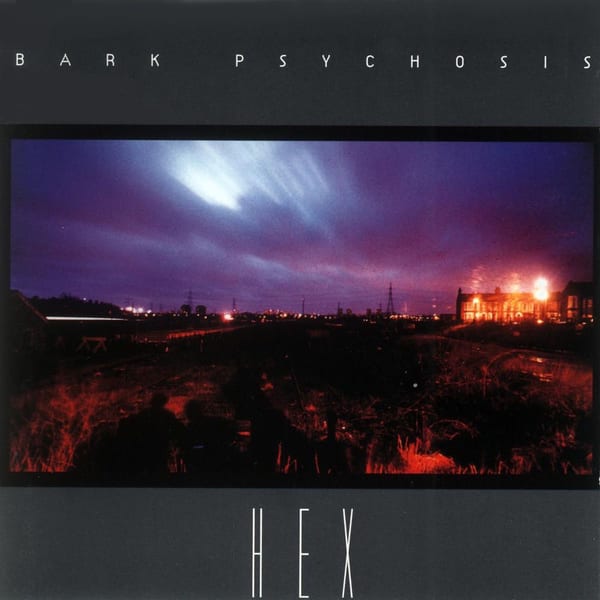
Here is a small, genuinely odd fact about one of the most argued-over words in music. The album that gave us "post-rock" sounds almost nothing like the music that word now describes.
Say post-rock to most people and they picture a specific thing: instrumental bands building long, wordless pieces toward an enormous distorted payoff. Guitars that murmur for six minutes and then knock you flat. Mogwai, Explosions in the Sky, Godspeed You! Black Emperor. The crescendo.
Hex, the record the term was minted to describe, has vocals. It has actual songs. And it has almost no crescendos in it at all.
The church record
Bark Psychosis made Hex through most of 1993 in St John's Church in Stratford, East London, where the band kept a rehearsal room. You can hear the room. The four of them — Graham Sutton on guitar and voice, John Ling on bass, Mark Simnett on drums, Daniel Gish on keys — worked slowly, patiently, closer to jazz musicians feeling out a space than to a rock band tracking parts. Trumpet drifts in. A vibraphone rings and decays. Sutton half-sings from somewhere near the back of the mix, more breath than statement.
The obvious ancestor was another band that had walked out of pop and into silence.
Talk Talk's Laughing Stock (1991), and Spirit of Eden before it, were built the same way: hours of improvisation in a darkened studio, edited down to something that breathes in and out instead of marching forward. Hex took that method somewhere colder and more urban, threading in dub space and the faint hum of a city outside the church walls. What it did not do was rock, in any sense a 1993 audience would recognize.
The word
In March 1994, Simon Reynolds reviewed Hex in Mojo, and that review is where he's usually credited with coining "post-rock." He widened it a couple of months later in a Wire essay that gave the idea room to stretch. His meaning was specific and, read now, almost quaint: rock instruments used for non-rock ends, guitars treated as sources of texture and timbre rather than riffs.
He wasn't describing one band. He had a loose cluster in mind — Bark Psychosis, Seefeel, Main, and a group of Londoners doing something even stranger with the same idea.
Disco Inferno's D.I. Go Pop (1994) is the other pole of what Reynolds meant, and there's a direct wire between the two bands: Daniel Gish played in Disco Inferno before he joined Bark Psychosis. Where Hex used space, Disco Inferno used overload, rigging their instruments to samplers so a guitar strum might trigger breaking glass or running water or a car crash. Neither record sounds remotely like a band waiting to explode. That was the whole idea. Post-rock, at the start, meant rock that had stopped needing the big finish.
What it became
Then the word got loose, and the music narrowed under it.
Across the late 1990s, one strain of instrumental rock hardened into a formula: quiet build, patient tension, huge cathartic release, repeat. It made some genuinely great records.
Mogwai's Young Team (1997) is one of them, and it earns its detonations. So does the vast, side-long ambition of Montreal's collective apocalypse.
Godspeed You! Black Emperor's Lift Yr. Skinny Fists Like Antennas to Heaven! (2000) is post-rock at its most sublime and its most template-setting at once. By the mid-2000s the crescendo had become such a reflex that the bands using it started apologizing, and "post-rock" turned into a mild insult in some corners — shorthand for a movie-trailer swell with no song underneath.
None of which has anything to do with Hex. The record that named the genre never took part in the thing the genre became. It sat off to the side the whole time, quiet, sung, uninterested in the big ending.
The vanishing
Bark Psychosis fell apart almost as soon as Hex came out. Sutton reinvented himself as a drum and bass producer under the name Boymerang, and the band effectively became him alone; the next record with the name on it, Codename: Dustsucker, didn't arrive until 2004, a decade later. So the album had no tour to sell it and no band left to defend it.
It grew anyway. In the absence of anyone pushing it, Hex became a word-of-mouth record, the kind you get handed by someone whose taste you trust. The retrospective verdicts kept climbing — a 9.0 from Pitchfork, a full ten from Uncut — and it settled into the strange status it holds now: a founding text almost nobody heard on time, revered most by the exact catalog-diving listeners who'd never call themselves post-rock fans.
That's the part I keep turning over. A genre took this album's name and walked off in the other direction, and the album was better for being left behind. It never had to compete in the lane it accidentally opened. If you want to trace where the word went instead, our post-rock guide follows the crescendo strain, and the first-wave guide picks up the quieter cousins standing next to Hex in 1994.
Put a number on it below, and settle an old argument for me: is Hex the best post-rock album ever made, or the proof that the label never fit it in the first place?
Discussion
Disagree? Have a better record in mind? Say it — top takes rise.
Sign in to join the discussion.
No one's weighed in yet. Go first.