

Discography
18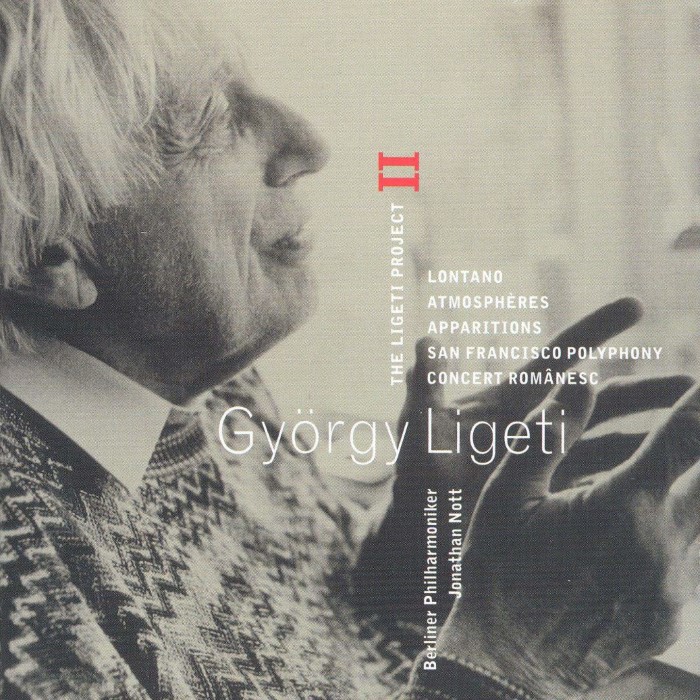
Most popular
The Ligeti Project II (Berliner Philharmoniker feat. conductor Jonathan Nott)
2002 · 9 tracks
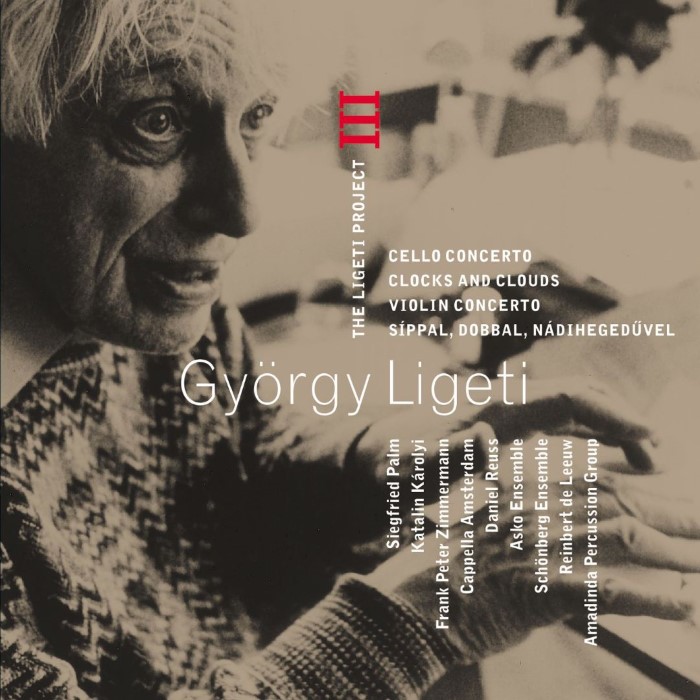
The Ligeti Project III
2002
Études pour piano (Toros Can)
2002
Un portrait
2000
Ligeti: Works for Piano & Cembalo
2000
The Ligeti Project I: Melodien / Chamber Concerto / Piano Concerto
2000
Le Grand Macabre (London Sinfonietta Voices & Philharmonia Orchestra feat. conductor: Esa-Pekka Salonen)
1999
Ligeti Edition 7: Chamber Music
1998
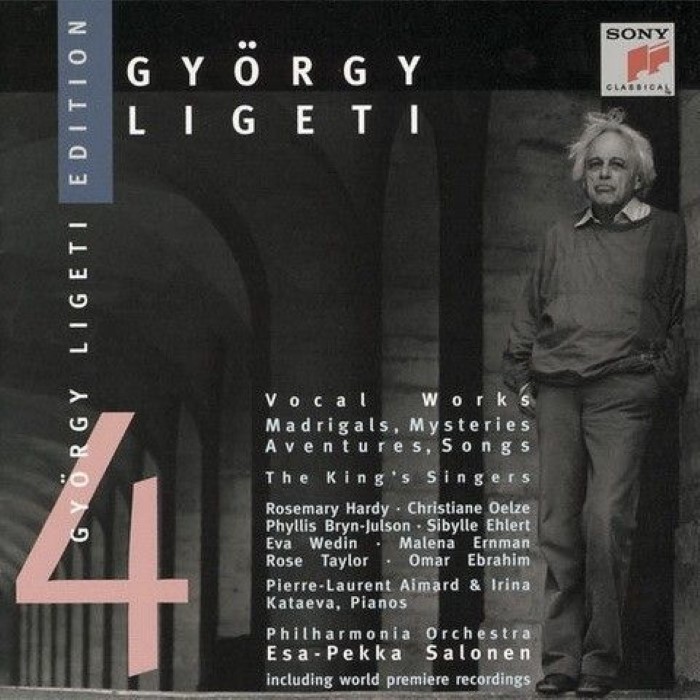
György Ligeti Edition 4: Vocal Works - Madrigals, Mysteries, Aventures, Songs (The King's Singers / Philharmonia Orchestra / Esa-Pekka Salonen)
1997
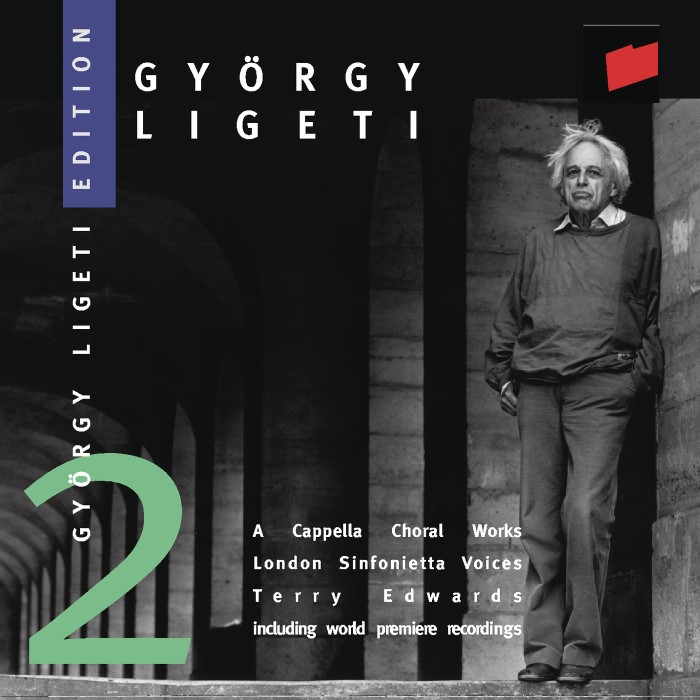
Ligeti Edition 2: A Cappella Choral Works (London Sinfonietta Voices feat. conductor: Terry Edwards)
1997
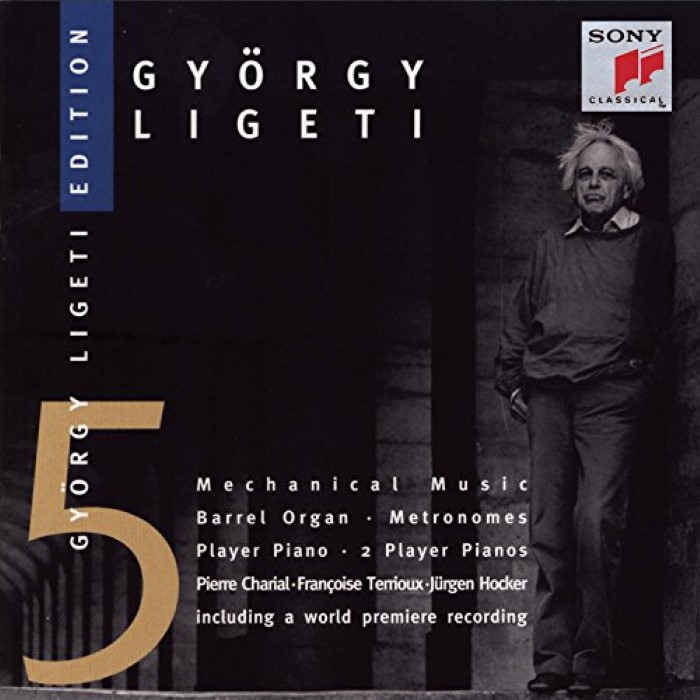
Ligeti Edition 5: Mechanical Music
1997
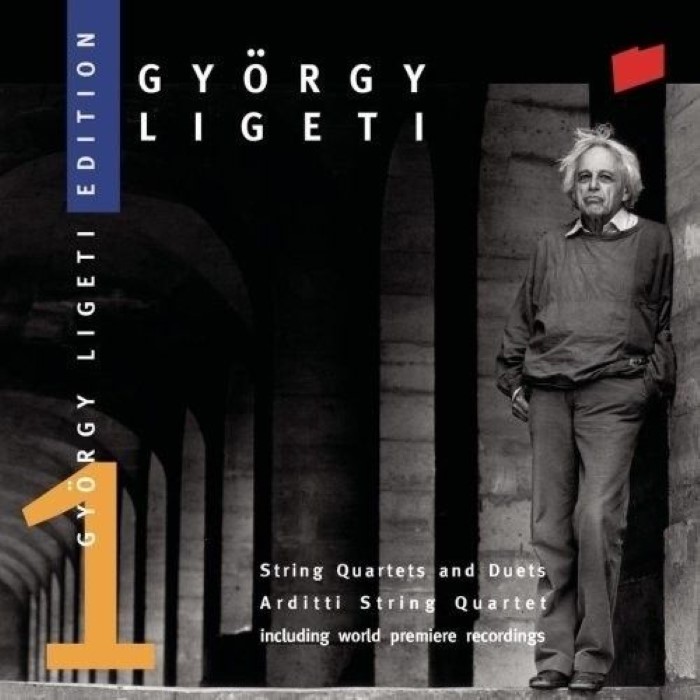
Ligeti Edition 1: String Quartets and Duets (Arditti String Quartet)
1997
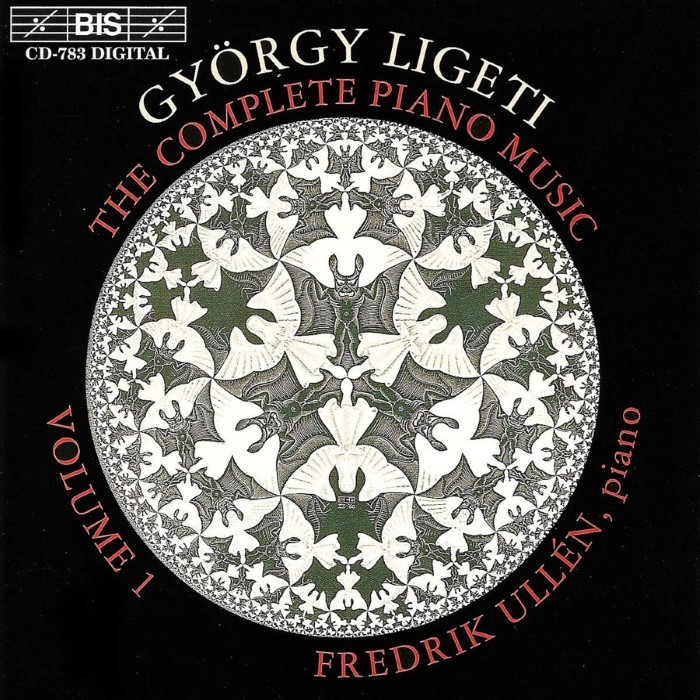
The Complete Piano Music, Volume I (Fredrik Ullén)
1996
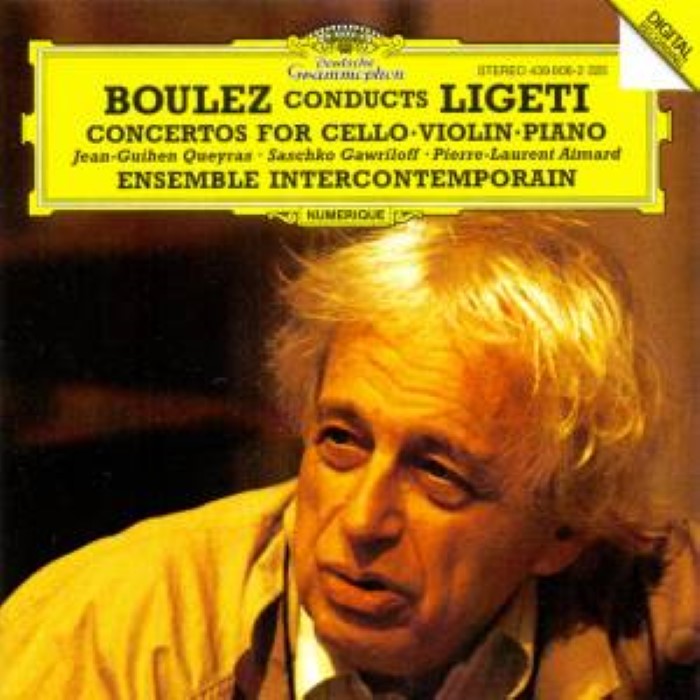
Boulez Conducts Ligeti: Concertos for Cello / Violin / Piano
1994
Concertos for Cello, Violin & Piano
1994
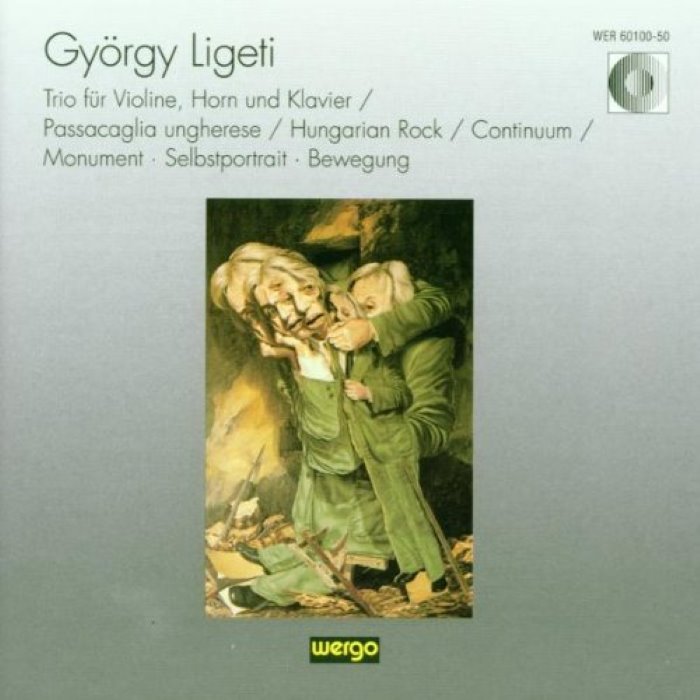
Trio für Violine, Horn und Klavier / Passacaglia ungherese / Hungarian Rock / Continuum / Monument · Selbstportrait · Bewegung
1993
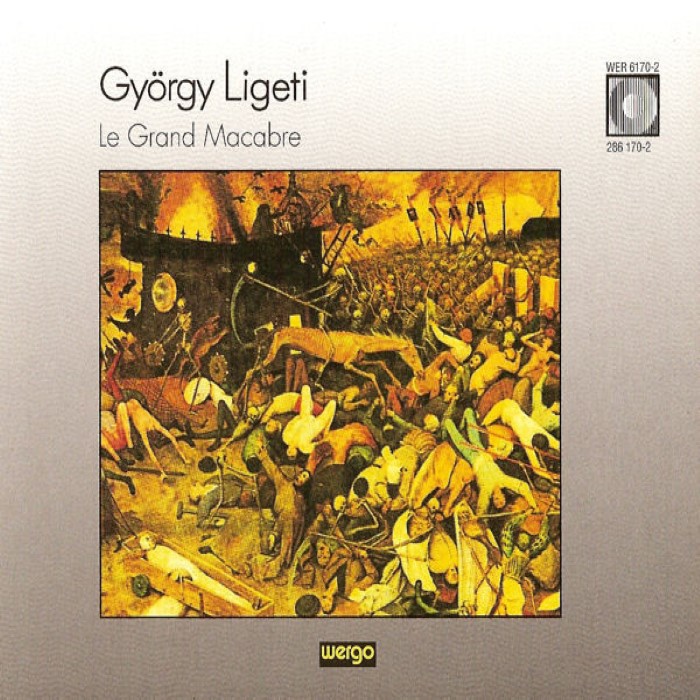
Le Grand Macabre
1991
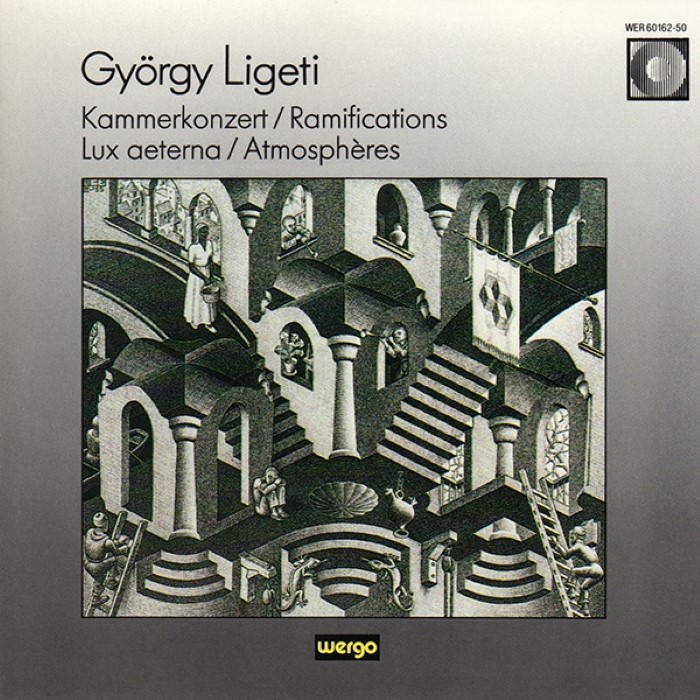
Kammerkonzert / Ramifications / Lux aeterna / Atmosphères
1988
Upcoming shows
Community
More about György Ligeti
About
György Sándor Ligeti (Hungarian: Ligeti György Sándor, ; May 28, 1923 – June 12, 2006) was a composer of contemporary classical music. Born in Transylvania, Romania, he lived in Hungary before emigrating and becoming an Austrian citizen. Early life : Ligeti was born in Dicsőszentmárton, which was renamed Târnăveni in 1945, in Transylvania to a Hungarian Jewish family. Ligeti recalls that his first exposure to languages other than Hungarian came one day while listening to a conversation among the Romanian-speaking town police. Before that he hadn't known that other languages existed. He moved to Cluj (Kolozsvár) with his family when he was 6, and he was not to return to the town of his birth until the 1990s. Ligeti received his initial musical training at the conservatory in Cluj, and during the summers privately with Pál Kadosa in Budapest.
Read moreRead less
In 1940, Northern Transylvania was occupied by Hungary following the Second Vienna Award. In 1944, Ligeti's education was interrupted when he was sent to a forced labor brigade by the Horthy regime. His brother, age 16, was deported to the Mauthausen concentration camp, and both of his parents were sent to Auschwitz. His mother was the only other survivor of his immediate family. Following the war, Ligeti returned to his studies in Budapest, Hungary, graduating in 1949 from the Franz Liszt Academy of Music. He studied under Pál Kadosa, Ferenc Farkas, Zoltán Kodály and Sándor Veress, and regularly attended lectures by Lajos Bárdos. He went on to do ethnomusicological research into the Hungarian folk music of Transylvania, but after a year returned to his old school in Budapest, this time as a teacher of harmony, counterpoint and musical analysis. However, communications between Hungary and the West by then had become difficult due to the restrictions of the communist government, and Ligeti and other artists were effectively cut off from recent developments outside the Soviet bloc. After leaving Hungary In December 1956, two months after the Hungarian revolution was violently suppressed by the Soviet Army, Ligeti fled to Vienna with his ex-wife Vera (soon to be wife again) and eventually took Austrian citizenship (in 1968). He would not see Hungary again until he was invited to judge a competition in Budapest fourteen years later. On his journey to Vienna, he left most of his Hungarian compositions in Budapest, some of which are now lost; he only took what he considered to be his most important compositions. He later explained, "I considered my old music of no interest. I believed in twelve-tone music!" A few weeks after arriving in Vienna, he left for Cologne. There he met several key avant-garde figures and learned more contemporary musical styles and methods. These included the composers Karlheinz Stockhausen and Gottfried Michael Koenig, both then working on groundbreaking electronic music. During the summer, he attended the Internationale Ferienkurse für Neue Musik in Darmstadt. Ligeti worked in the Cologne studio with Stockhausen and Koenig and was inspired by the sounds he heard there. However, he produced little electronic music of his own, instead concentrating on instrumental works which often contain electronic-sounding textures. After about three years, he finally fell out with the Cologne school, because it was too dogmatic and there was a huge amount of factional in-fighting: "There were a lot of political fighting because different people, like Stockhausen, like Kagel wanted to be first. And I, personally, have no ambition to be first or to be important." Starting around 1960, Ligeti's work became better-known and respected. His best-known work include works in the period from Apparitions (1958–59) to Lontano (1967) and his opera Le Grand Macabre (1978). In recent years, his three books of Études for piano (1985–2001) have become better-known through recordings by Pierre-Laurent Aimard, Fredrik Ullén, and others. In 1973, Ligeti became professor of composition at the Hamburg Hochschule für Musik und Theater, eventually retiring in 1989. In the early 1980s, he tried to find a new stylistic position (closer to "tonality"), leading to an absence from the musical scene for several years until he reappeared with the Trio for Violin, Horn and Piano (1982). His output was prolific through the 1980s and 1990s. Invited by Walter Fink, he was the first composer featured in the annual Komponistenporträt of the Rheingau Musik Festival in 1990. owever, health problems became severe after the turn of the millennium. On June 12, 2006, Ligeti died in Vienna at the age of 83. Although it was known that Ligeti had been ill for several years and had used a wheelchair the last three years of his life, his family declined to release the cause of his death. Ligeti's funeral was held at the Vienna Crematorium at the Zentralfriedhof, the Republic of Austria and the Hungary Republic of Hungary represented by their respective cultural affairs ministers. The ashes were finally buried at the Zentralfriedhof in a grave dedicated to him by the City of Vienna. Apart from his far-reaching interest in different types of music from Renaissance to African music, Ligeti was also interested in literature (including the writers Lewis Carroll, Jorge Luis Borges, and Franz Kafka), painting, architecture, science, and mathematics, especially the fractal geometry of Benoît Mandelbrot and the writings of Douglas Hofstadter. Ligeti was the grand-nephew of the violinist Leopold Auer. Ligeti's son, Lukas Ligeti, is a composer and percussionist based in New York City. Years in Hungary : Many of his very earliest works were written for chorus and set folk songs. His largest work in this period was a graduation composition for the Budapest Academy, entitled Cantata for Youth Festival, for four vocal soloists, chorus, and orchestra. One of his earliest pieces now in the repertoire is his Cello Sonata, a work in two contrasting movements written in 1948 and 1953 respectively. It was initially banned by the Soviet-run Composer's Union and had to wait a quarter of a century before its first public performance. Ligeti's earliest works are often an extension of the musical language of Béla Bartók. Even his piano cycle, Musica ricercata (1953), though written according to Ligeti with a "Cartesian" approach in which he "regarded all the music I knew and loved as being... irrelevant", has been described by one biographer as inhabiting a world very close to Bartók's set of piano works, Mikrokosmos. Ligeti's set comprises eleven pieces in all. The work is based on a simple restriction: the first piece uses exclusively one pitch A, heard in multiple octaves, and only at the very end of the piece is a second note, D, heard. The second piece then uses three notes (E♯, F♯, and G), the third piece uses four, and so on, so that in the final piece all twelve notes of the chromatic scale are present. Shortly after its composition, Ligeti arranged six of the movements of Musica ricercata for wind quintet under the title Six Bagatelles for Wind Quintet. The Bagatelles were performed first in 1956, but not in their entirety; the last movement was censored by the Soviets for being too 'dangerous'. Because of Soviet censorship, his most daring works from this period, including Musica ricercata and String Quartet No. 1 Métamorphoses nocturnes (1953–1954), were written for the 'bottom drawer'. Composed of a single movement divided into seventeen contrasting sections linked motivically, the First String Quartet is Ligeti's first work to suggest a personal style of composition. The string quartet was not performed until 1958, after he had fled Hungary for Vienna. From 1956 to Le Grand Macabre Upon arriving in Cologne, he began to write electronic music alongside Karlheinz Stockhausen and Gottfried Michael Koenig at the electronic studio of West German Radio (WDR). He completed only two works in this medium, however—the pieces Glissandi (1957) and Artikulation (1958)—before returning to instrumental music. A third work, originally entitled Atmosphères but later known as Pièce électronique Nr. 3, was planned, but the technical limitations of the time prevented Ligeti from realizing it completely. It was finally realized in 1996 by the Dutch composers Kees Tazelaar and Johan van Kreij of the Institute of Sonology. Aventures, like its companion piece Nouvelles Aventures, is a composition for three singers and instrumental septet, to a text semantically without meaning of Ligeti's own devising. Each of the singers has five roles to play, exploring five areas of emotion, and they switch from one to the other so quickly and abruptly that all five areas are present throughout the piece. Ligeti's music appears to have been subsequently influenced by his electronic experiments, and many of the sounds he created resembled electronic textures. The texture used in the second movement of Apparitions and Atmosphères Ligeti would later dub "micropolyphony". The Requiem is a work for soprano and mezzo-soprano soloists, twenty-part chorus (four each of soprano, mezzo-soprano, alto, tenor, and bass), and orchestra. Though, at about half an hour, it is the longest piece he had composed up to that point, Ligeti sets only about half of the Requiem's traditional text: the Introitus, the Kyrie (a completely chromatic quasi-fugue, where the parts are a montage of melismatic and skipping micropolyphony), and the Dies irae—dividing the latter sequence into two parts, De die iudicii sequentia (Day of Judgement Sequence) and Lacrimosa (Weeping). Lux Aeterna is a 16-voice a cappella piece whose text is also associated with the Latin Requiem. String Quartet No. 2 consists of five movement. They differ widely from each other in their types of motion. In the first, the structure is largely broken up, as in Aventures. In the second, everything is reduced to very slow motion, and the music seems to be coming from a distance, with great lyricism. The pizzicato third movement is another of Ligeti's machine-like studies, hard and mechanical, whereby the parts playing repeated notes creates a "granulated" continuum. In the fourth, which is fast and threatening, everything that happened before is crammed together. Lastly, in strong contrast, the fifth movement spreads itself out. In each movement, the same basic configurations return, but each time their coloring or viewpoint is different, so that the overall form only really emerges when one listens to all five movements in context. Ramifications, completed a year before the Chamber Concerto, is scored for an ensemble of strings in twelve parts—seven violins, two violas, two cellos and a double bass—each of which may be taken by one player or several. The twelve are divided into two numerically equal groups but with the instruments in the first group tuned approximately a quarter-tone higher (four violins, a viola and a cello). As the group play, the one tuned higher inevitably tends to slide down toward the other, and both get nearer each other in pitch. In the Chamber Concerto, several layers, processes and kinds of movement can take place on different planes simultaneously. In spite of frequent markings of "senza tempo", the instrumentalists are not given linear freedom; Ligeti insists on keeping his texture under strict control at any given moment. The form is like a "precision mechanism". Ligeti has always been fascinated by machines that do not work properly and by the world of technology and automation. The ticking of periodic mechanical noises of not-quite-reliable machinery occurs in many of his works. The scoring is for flute (doubling piccolo), oboe (doubling oboe d'amore and English horn), clarinet, bass clarinet (doubling second clarinet), horn, trombone, harpsichord (doubling Hammond organ), piano (doubling celesta), and solo string quartet. From the 1970s, Ligeti turned away from total chromaticism and began to concentrate on rhythm. Pieces such as Continuum (1968) and Clocks and Clouds (1972–73) were written before he heard the music of Steve Reich and Terry Riley in 1972. But the second of his Three Pieces for Two Pianos, entitled "Self-portrait with Reich and Riley (and Chopin in the background)," commemorates this affirmation and influence. During the 1970s, he also became interested in the polyphonic pipe music of the Banda-Linda tribe from the Central African Republic, which he heard through the recordings of one of his students. In 1977, Ligeti completed his only opera, Le Grand Macabre, thirteen years after its initial commission. Loosely based on Michel de Ghelderode's 1934 play, La Balade du grand macabre, it is a work of Absurd theatre—Ligeti called it an "anti-anti-opera"—in which Death (Nekrotzar) arrives in the fictional city of Breughelland and announces that the end of the world will occur at midnight. Musically, Le Grand Macabre draws on techniques not associated with Ligeti's previous work, including quotations and pseudo-quotations of other works and the use of consonant thirds and sixths. After Le Grand Macabre, Ligeti would abandon the use of pastiche, but would increasingly incorporate consonant harmonies (even major and minor triads) into his work, albeit not in a diatonic context. After Le Grand Macabre After Le Grand Macabre, Ligeti struggled for some time to find a new style. Besides two short pieces for harpsichord, he did not complete another major work until the Trio for Violin, Horn and Piano in 1982, over four years after the opera. His music of the 1980s and 1990s continued to emphasize complex mechanical rhythms, often in a less densely chromatic idiom, tending to favor displaced major and minor triads and polymodal structures. During this time, Ligeti also began to explore alternate tuning systems through the use of natural harmonics for horns (as in the Horn Trio and Piano Concerto) and scordatura for strings (as in the Violin Concerto). Additionally, most of his works in this period are multi-movement works, rather than the extended single movements of Atmosphères and San Francisco Polyphony. From 1985 to 2001, Ligeti completed three books of Études for piano (Book I, 1985; Book II, 1988–94; Book III, 1995–2001). Comprising eighteen compositions in all, the Études draw from a diverse range of sources, including gamelan, African polyrhythms, Béla Bartók, Conlon Nancarrow, Thelonious Monk, and Bill Evans. Book I was notably written as preparation for the Piano Concerto, which contains a number of similar motivic and melodic elements. In 1988, Ligeti completed his Piano Concerto, a work which he described as a statement of his "aesthetic credo". Initial sketches of the Concerto began in 1980, but it was not until 1986 that he found a way forward and the work proceeded more quickly. The Concerto explores many of the ideas worked out in the Études but in an orchestral context. In 1993, Ligeti completed his Violin Concerto after four years of work. Like the Piano Concerto, the Violin Concerto uses the wide range of techniques he had developed up until that point as well as the new ideas he was working out at the moment. Among other techniques, it uses "microtonality, rapidly changing textures, comic juxtapositions... Hungarian folk melodies, Bulgarian dance rhythms, references to medieval and Renaissance music and solo violin writing that ranges from the slow-paced and sweet-toned to the angular and fiery." Other notable works from this period are the Viola Sonata (1994) and the Nonsense Madrigals (1988–93), a set of six a cappella compositions that set English texts from William Brighty Rands, Lewis Carroll, and Heinrich Hoffman. The third Madrigal is based on the alphabet. Ligeti's last works were the Hamburg Concerto for solo horn, four natural horns and chamber orchestra (1998–99, revised 2003, dedicated to Marie Luise Neunecker), the song cycle Síppal, dobbal, nádihegedüvel ("With Pipes, Drums, Fiddles", 2000), and the eighteenth piano étude "Canon" (2001). After Le Grand Macabre, Ligeti planned to write a second opera, first to be based on Shakespeare's The Tempest and later on Carroll's Alice's Adventures in Wonderland, but neither piece ever came to fruition. Polyrhythm Ligeti’s music from the last two decades of his life is unmistakable for its rhythmic complexity. Writing about his first book of Piano Etudes, the composer claims this rhythmic complexity stems from two vastly different sources of inspiration: the Romantic-era piano music of Chopin and Schumann and the indigenous music of sub-Saharan Africa. The difference between the earlier and later pieces lies in a new conception of pulse. In the earlier works, the pulse is something to be divided into two, three and so on. The effect of these different subdivisions, especially when they occur simultaneously, is to blur the aural landscape, creating the micropolyphonic effect of Ligeti’s music. On the other hand, the later music (and a few earlier pieces such as Continuum) conceives of the pulse as a musical atom, a common denominator, a basic unit which cannot be divided any further. Different rhythms appear through multiplications of the basic pulse, rather than divisions: this is the principle of African music seized on by Ligeti. It also appears in the music of Philip Glass, Steve Reich and others; and significantly it shares much in common with the additive rhythms of Balkan folk music, the music of Ligeti’s youth. In popular culture Ligeti's music is best known to the general public for its use in the films of Stanley Kubrick. The soundtrack to 2001: A Space Odyssey includes excerpts from four of his pieces: Atmosphères, Lux Aeterna (for the moon-bus scene en route to the TMA-1 monolith in the crater Tycho), Requiem (the Kyrie), and an electronically altered version of Aventures (in the cryptic final scenes). The usage and modification happened without Ligeti's knowledge and without full copyright clearance; when the film came to Ligeti's attention, he "successfully sued for having had his music distorted", but settled out of court with Kubrick in return for the (compensated) use of his music in later films. Some of this music was used again in Peter Hyams's 1984 sequel film, 2010. Another of Kubrick's films, The Shining, uses Lontano for orchestra. In addition, the second movement of Ligeti's Musica ricercata is used at pivotal moments in Eyes Wide Shut. Lontano was also used in Martin Scorsese's Shutter Island. Lontano, Melodien, and Volumina were used in the first radio series of The Hitchhiker's Guide to the Galaxy as background music to sections of narrative from the Guide. Lontano, Atmosphères, and the first movement of the Cello Concerto were used in Sophie Fiennes's documentary Over Your Cities Grass Will Grow, about the German post-war artist Anselm Kiefer. The first movement of the Cello Concerto was also used in the Michael Mann film Heat starring Al Pacino and Robert De Niro.
György Ligeti in brief
- How many György Ligeti releases are on Riffiter?
- 18 releases are catalogued, spanning 1988 to 2002.
- What is the most recent György Ligeti release on Riffiter?
- The Ligeti Project II (Berliner Philharmoniker feat. conductor Jonathan Nott), released in 2002.